New Year's food traditions look wildly different from country to country, but almost all of them are betting on one of three things: money, luck, or a long life. Lentils in Italy and black-eyed peas in the American South are coins. Twelve grapes in Spain are twelve months. Long soba noodles in Japan are a long life. Pork shows up nearly everywhere because a pig roots forward, and chicken gets avoided because a chicken scratches backward. Once you see the pattern, the whole global map stops being a list of quirky customs and becomes one very old idea expressed in whatever people had to cook with.
The three wishes
Strip away the country names and nearly every New Year's food on earth resolves to a wish for money, a wish for luck, or a wish for more time.
What is striking is how literal the symbolism is. These are not subtle metaphors. The food gets chosen because of what it looks like, or because of how the animal it came from moves. Lentils are small flat discs, so they are coins. Collard greens are leafy and fold, so they are paper money. Noodles are long, so they are long life. Round fruit is round like a coin, so it is money again.
That literalism is a clue about age. Symbols this blunt tend to come from a time when most people could not read, when a thing had to mean what it resembled. The traditions survived because they were easy to teach to a child and easy to do with whatever was cheap and in season in late December.
| Tradition | Where | What it's supposed to buy |
|---|---|---|
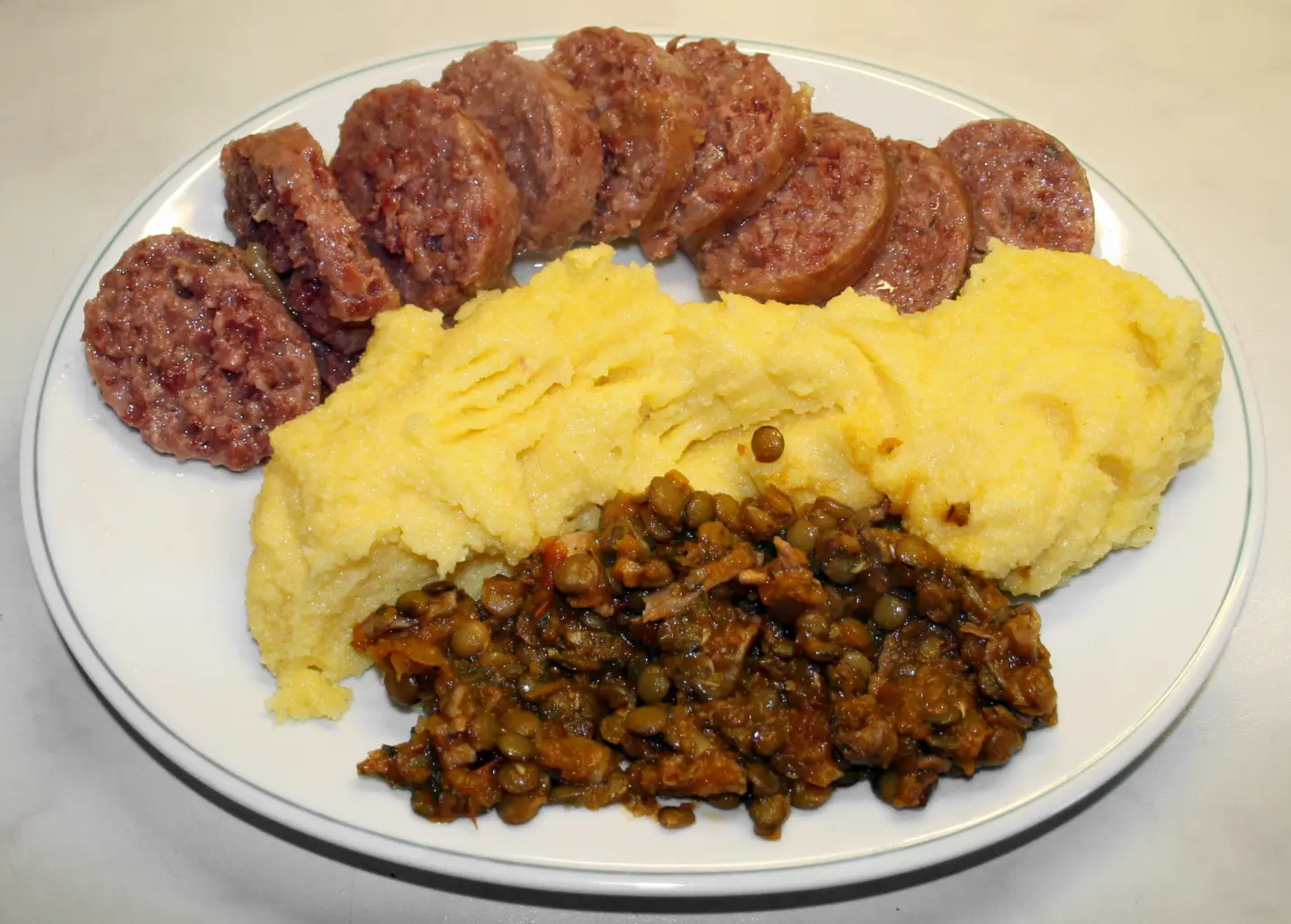
| Lentils, often with cotechino | Italy | Money: coins |
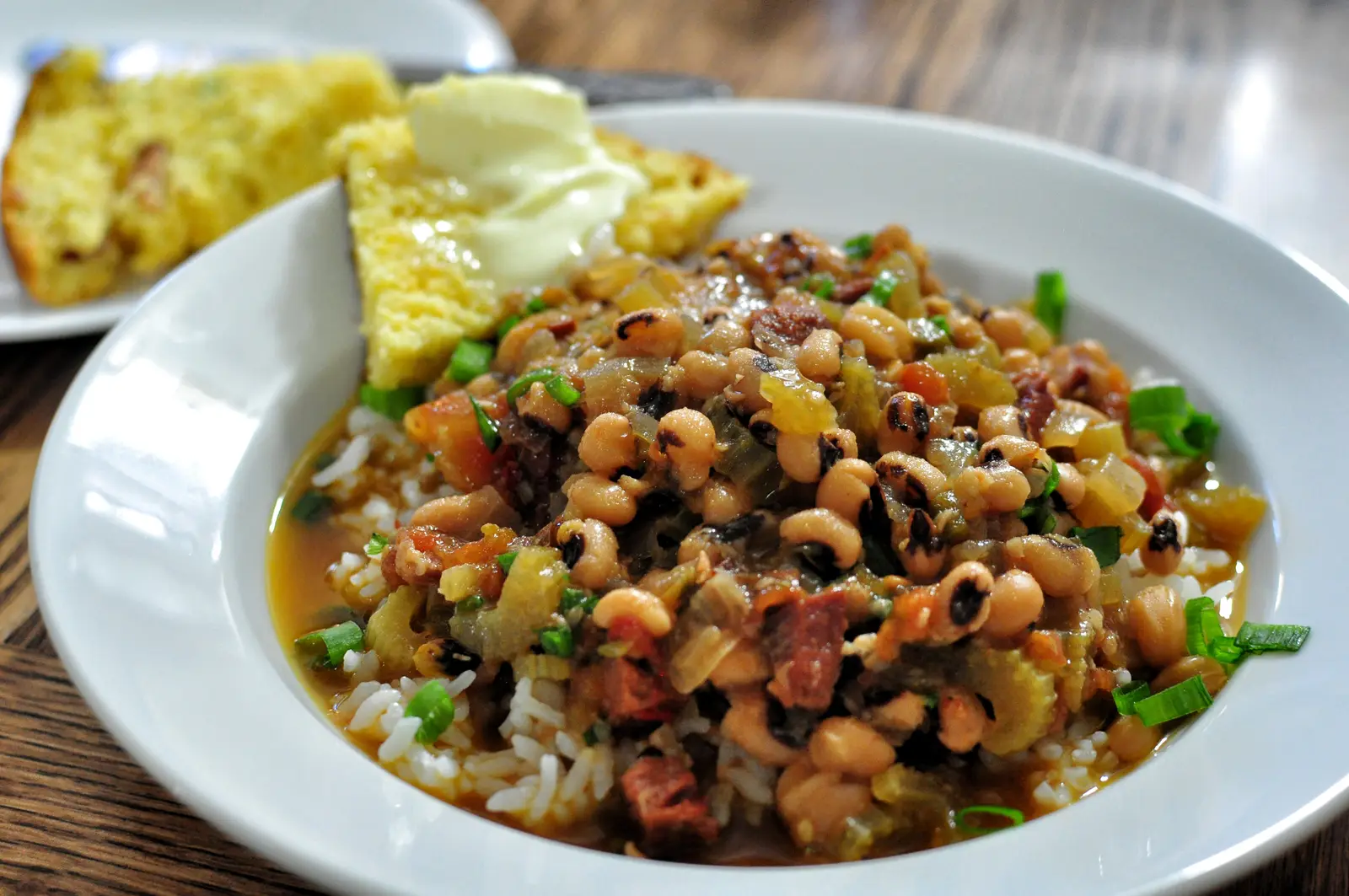
| Black-eyed peas, collards, cornbread | American South | Coins, paper money, gold |
| Twelve grapes at midnight | Spain, Latin America | Luck, one month at a time |
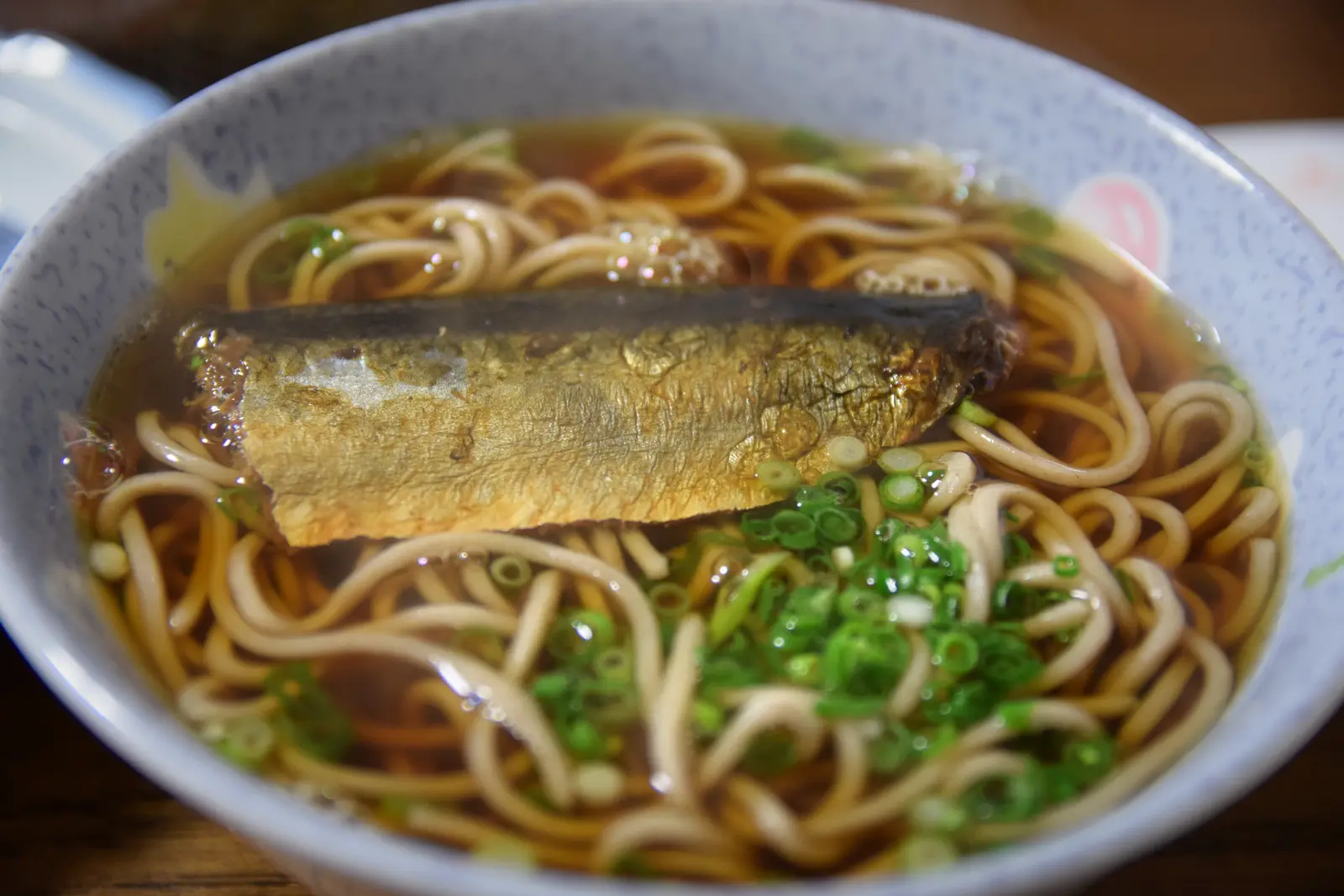
| Toshikoshi soba | Japan | Long life, and cutting off the old year |
| Round fruits, often twelve | Philippines | Money, one per month |
| Pork in almost any form | Much of Europe and the Americas | Progress: pigs root forward |
| Long noodles | China | Long life: never cut them |
| Pomegranate smashed on the threshold | Greece | Abundance |
Foods that mean money
Italy eats lentils, usually on New Year's Eve and usually with cotechino, a fat, soft pork sausage that gets simmered for hours. The lentils are the coins and the pork is the progress, so the plate is making two arguments at once. It is also, incidentally, very good food, which is not something you can say about every tradition on this list.
The American South runs the same play with different crops. Black-eyed peas are the coins, collard greens are folded bills, cornbread is gold. Together they make hoppin' john and its standard accompaniments, and the Lowcountry version has a history considerably older and more serious than the luck charm it usually gets reduced to.
The Philippines goes for round fruit, often twelve pieces, one for each month, because round is coin-shaped. Polka dots on your clothes work on the same logic. Once you accept that the rule is "round equals money," the rest follows, and Filipino households tend to follow it further than most: coins in the pocket, coins on the table, something round in every direction.
Greece does something more theatrical. A vasilopita, a cake baked for New Year's Day, has a coin hidden inside it. The cake gets cut in a fixed order, oldest to youngest or house first then family, and whoever gets the slice with the coin has the luck for the year. The symbolism has stopped being a metaphor at this point. There is simply money in the cake.
The Greek pomegranate is blunter still. You smash it on the doorstep at midnight, and the more seeds that scatter, the better the year. A fruit packed with hundreds of red seeds is about as direct a picture of abundance as produce gets.
What all of these share is that the money wish is the most common of the three by a wide margin. Luck is vague and a long life is abstract, but everybody understands a coin.
Foods that mean luck, and the ones that mean the opposite
Pork is the most widespread New Year's food on earth, and the reasoning given almost everywhere is the same: a pig pushes its snout forward through the dirt. Forward is the direction you want the year to go. Germany, Austria, Spain, Cuba, Puerto Rico, the American South, Pennsylvania Dutch country with its pork and sauerkraut. Different pigs, same argument.
The inverse is where it gets interesting, because the avoidances are more specific than the recommendations.
- Chicken and turkey are widely avoided, because birds scratch backward. Serving one is said to drag the year behind you.
- Lobster is avoided for the same structural reason, since lobsters swim backward.
- Anything with wings gets skipped in some places on the grounds that your luck will fly away.
- White foods are avoided in parts of China around the lunar new year for their association with mourning.
I find the avoidances more revealing than the lucky foods. It is easy to believe that eating a lentil might help. Deciding that a specific animal will actively ruin your year takes real commitment to the system.
Foods that mean a long life
Japan eats toshikoshi soba on New Year's Eve, usually close to midnight. The name translates roughly to year-crossing noodles, and it carries two meanings at once. The noodles are long, so they are long life. But soba is buckwheat and brittle, easy to bite clean through, so eating it also severs the hardships of the year you are leaving. One bowl, two jobs.
China runs longevity noodles on a stricter rule: do not cut them, and try not to bite them off, because the length is the point. It is one of the few traditions on this list where the technique of eating matters as much as the food.
Both are more elegant than most of what is on this page. A long noodle for a long life is the same literal logic as a lentil for a coin, but it asks something of you at the table.
Korea takes the time idea somewhere else entirely. On New Year's Day, households eat tteokguk, a clear soup with thin oval slices of rice cake, and eating it is understood to be how you turn a year older. Not a wish for more time, a transaction in it. There is a running joke about declining a second bowl to avoid aging twice, which tells you the tradition is alive enough to be made fun of.
That is the detail I would keep if I could keep only one from this entire page. Everywhere else the food is a request. In Korea the food is the mechanism.
The twelve grapes
Spain eats twelve grapes at midnight, one on each stroke of the clock, one wish for each month of the coming year. It has spread across most of Latin America, and it is the one tradition on this list that is genuinely difficult to pull off. Twelve grapes in twelve seconds is more grape than it sounds.
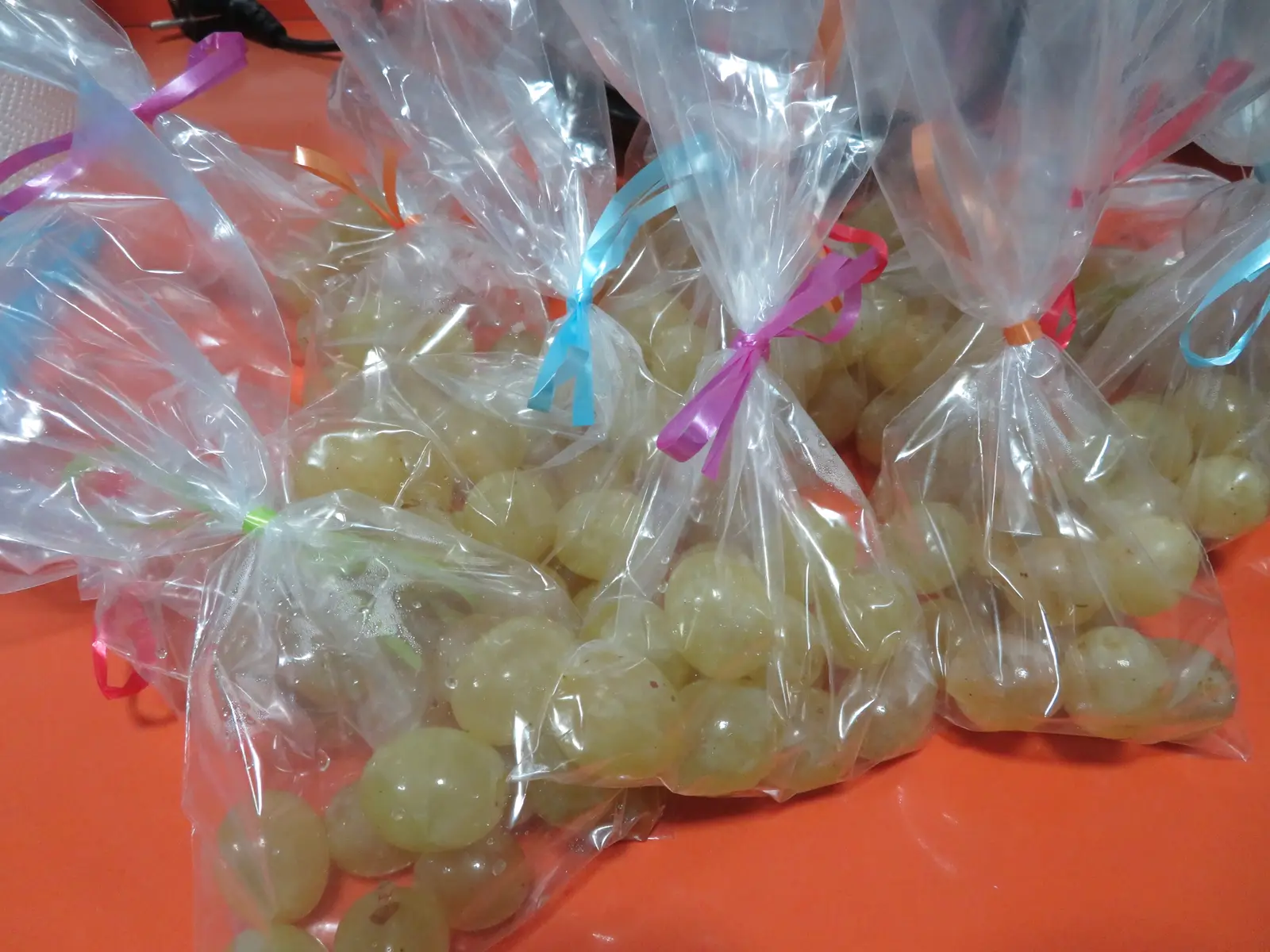
The origin story you will read most often is that growers in Alicante invented it in 1909 to move a surplus harvest, selling the extra fruit in packs of twelve as uvas de la suerte. That happened, and it clearly supercharged the custom. But it probably did not start it. The practice is documented before then, with accounts pointing to Madrid in the 1880s and 1890s, where it seems to have begun as imitation of a French habit of grapes and champagne at midnight and as crowds gathering under the clock at Puerta del Sol. CBS News notes that the true origins are hard to trace.
So the honest version is that a marketing campaign took a custom that already existed and made it national. That is a more interesting story than either "ancient tradition" or "invented by grape farmers," and it is closer to how most food traditions actually work.
The table I actually grew up at
Here is the thing none of the country-by-country lists will tell you: almost nobody eats like the list says they do.
I grew up in New York in a Colombian family, on a block that was mostly Puerto Rican. So the end-of-year table was Colombian tamales next to a pernil on the Nochebuena table, arroz con gandules, and pasteles, which are a kind of tamal made from green banana and plantain masa with meat buried in the middle and the whole thing boiled in a leaf.
Then there were natilla and buñuelos from my family's side, and at midnight, the twelve grapes.
Nobody explained any of it. Not once. I did not know a lentil was supposed to be a coin or that the grapes were twelve because the year has twelve months. I am not sure the adults knew either. It was just what was on the table, and it was good, and that was the entire reason anyone did it.
That is closer to how these traditions actually survive than any explanation on this page. They do not persist because people believe the symbolism. They persist because somebody made the thing every year, and then you make it, because not making it would feel wrong.
It is also why the tidy country-by-country version of this subject is slightly false. The map it draws stopped being accurate the moment anybody moved. A Colombian family in New York ends up eating a Puerto Rican pork shoulder because that is what the neighbors were roasting and somebody brought a plate over. A Puerto Rican family in Orlando picks up black-eyed peas because that is what the South does. Traditions are not sorted by passport. They are sorted by proximity.
The honest version of "New Year's food around the world" is that most people's table is a mix, assembled out of where they came from and where they landed, and that the mixing is not a dilution of the tradition. It is the tradition working exactly as it always has.
Which of these are actually worth eating
A chef's honest sort, now that the anthropology is out of the way.
Genuinely good food that happens to be a tradition: cotechino and lentils, which is a legitimately excellent cold-weather dish. Hoppin' john, properly made with the rice cooked in the pea liquor. Pernil and arroz con gandules, which do not need a holiday. Toshikoshi soba, which is a good bowl of noodles.
Tradition first, dinner second: pork and sauerkraut, which is fine and which nobody is making in July. Twelve grapes, which is a stunt, not a course.
Skip entirely: anything you are choking down because an internet listicle said a lobster swims backward.
This is the same mechanism behind why nobody actually wants a better turkey at Thanksgiving. The food is not being judged as food. It is doing a different job, and improving it can make it worse at that job.
FAQ
What are the most common New Year's food traditions?
Lentils in Italy, black-eyed peas with collard greens and cornbread in the American South, twelve grapes at midnight in Spain and Latin America, toshikoshi soba in Japan, round fruits in the Philippines, and pork almost everywhere. Nearly all of them symbolize money, luck, or a long life.
Why do people eat lentils on New Year's?
Because lentils are small, flat and round, so they look like coins. Italians typically eat them on New Year's Eve with cotechino, a slow-simmered pork sausage, pairing the money symbolism of the lentils with the forward-moving symbolism of the pig.
Why do you eat twelve grapes at midnight?
One grape per stroke of the clock, one wish per month of the coming year. The custom is Spanish and spread widely through Latin America. Grape growers in Alicante popularized it in 1909 by selling surplus fruit in packs of twelve, but the practice is documented earlier, so they amplified it rather than inventing it.
What foods are considered bad luck on New Year's?
Chicken and turkey, because birds scratch backward. Lobster, because it swims backward. Winged animals in some traditions, on the theory that your luck flies off. The logic is consistent: anything that moves backward drags your year with it.
Why is pork eaten on New Year's Day?
Because a pig roots forward with its snout, which reads as moving into the year rather than back into the old one. It is the most widely shared New Year's food logic there is, showing up from Germany and Austria through Spain, Cuba, Puerto Rico and the American South.
Make the thing your family makes. If nobody in your family made anything, pick a pot from this page and make it twice, two years running. That is the entire mechanism by which any of this started.