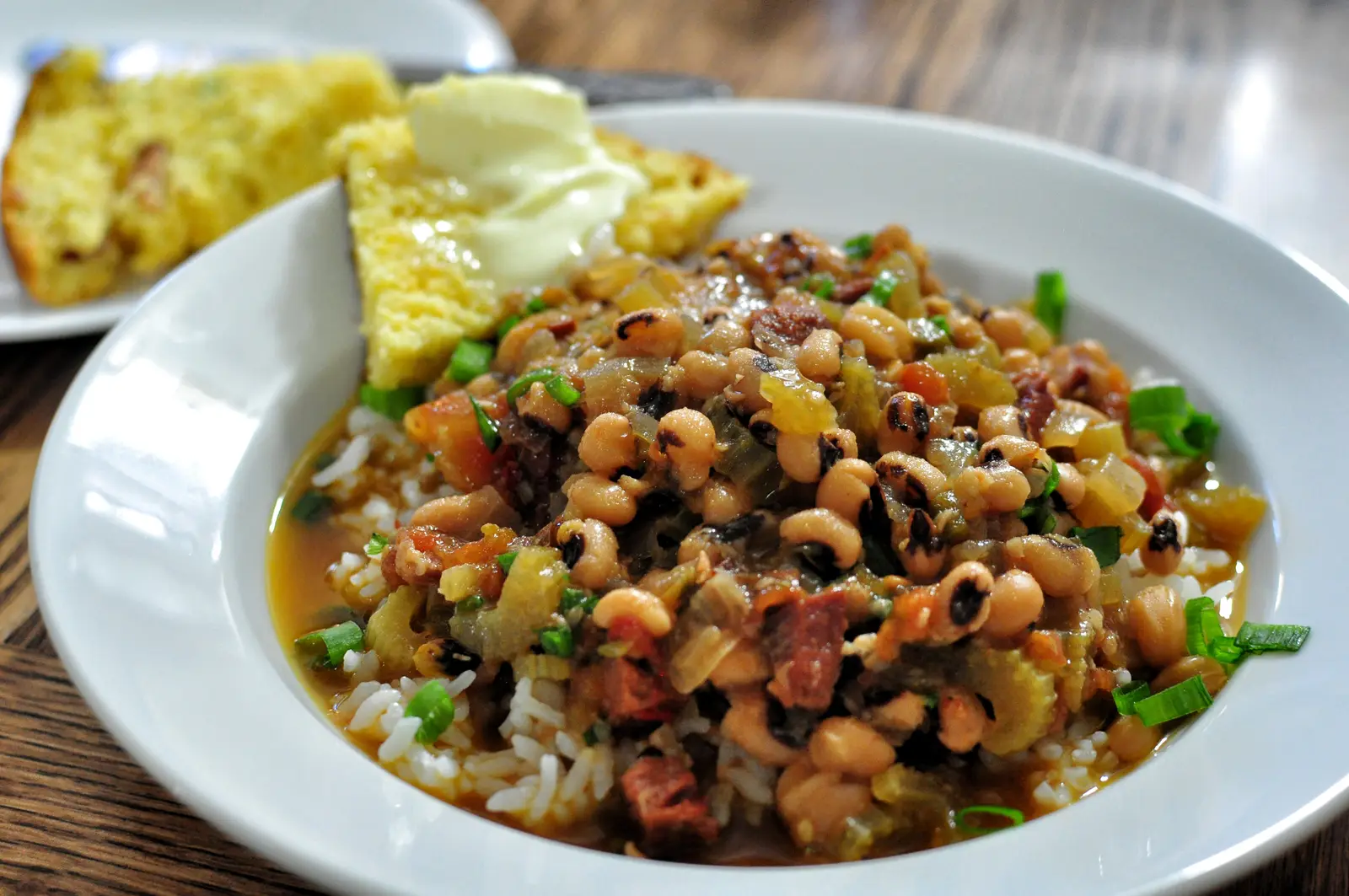
Hoppin' john is a Lowcountry dish of field peas and rice cooked with smoked pork, eaten across the American South on New Year's Day for luck. The traditional method is simple: simmer dried peas with a piece of smoky pork until the liquid turns dark and savory, then cook the rice in that liquid rather than in water. That one decision is the whole dish. Most recipes online stop at "peas and rice for good luck," which skips the part worth knowing. This is West African rice cooking that survived the Middle Passage, and the earliest printed version of it is older than the Civil War.
What hoppin' john actually is
Three things in one pot: a field pea, rice, and a cured pork product. Everything else is regional argument.
The pea matters more than people think. Today it is almost always the black-eyed pea, but the older Charleston versions called for red cowpeas, a smaller, denser, earthier field pea. Both are cowpeas, both came from Africa, and the black-eyed pea won mostly because it became the one you could buy anywhere.
The pork is bacon, salt pork, a ham hock, or a smoked turkey wing in houses that do not cook pork. Its job is to put smoke and salt into the cooking liquid.
And the rice is not a side. It is cooked in the pea liquor, which is the thing that separates hoppin' john from peas served next to rice. Boil your rice in water, spoon peas over it, and you have made something perfectly good that is not this dish.
Where it actually came from
The Carolina Lowcountry grew rice because the people forced to work there already knew how. Planters in South Carolina and Georgia specifically sought captives from the rice-growing regions of West Africa, and the agricultural knowledge that built the Carolina rice economy came with them. The South Carolina Encyclopedia's entry on the dish places it squarely in that context, and the Post and Courier has covered how enslaved Africans shaped Lowcountry bean-and-rice cooking in more detail.
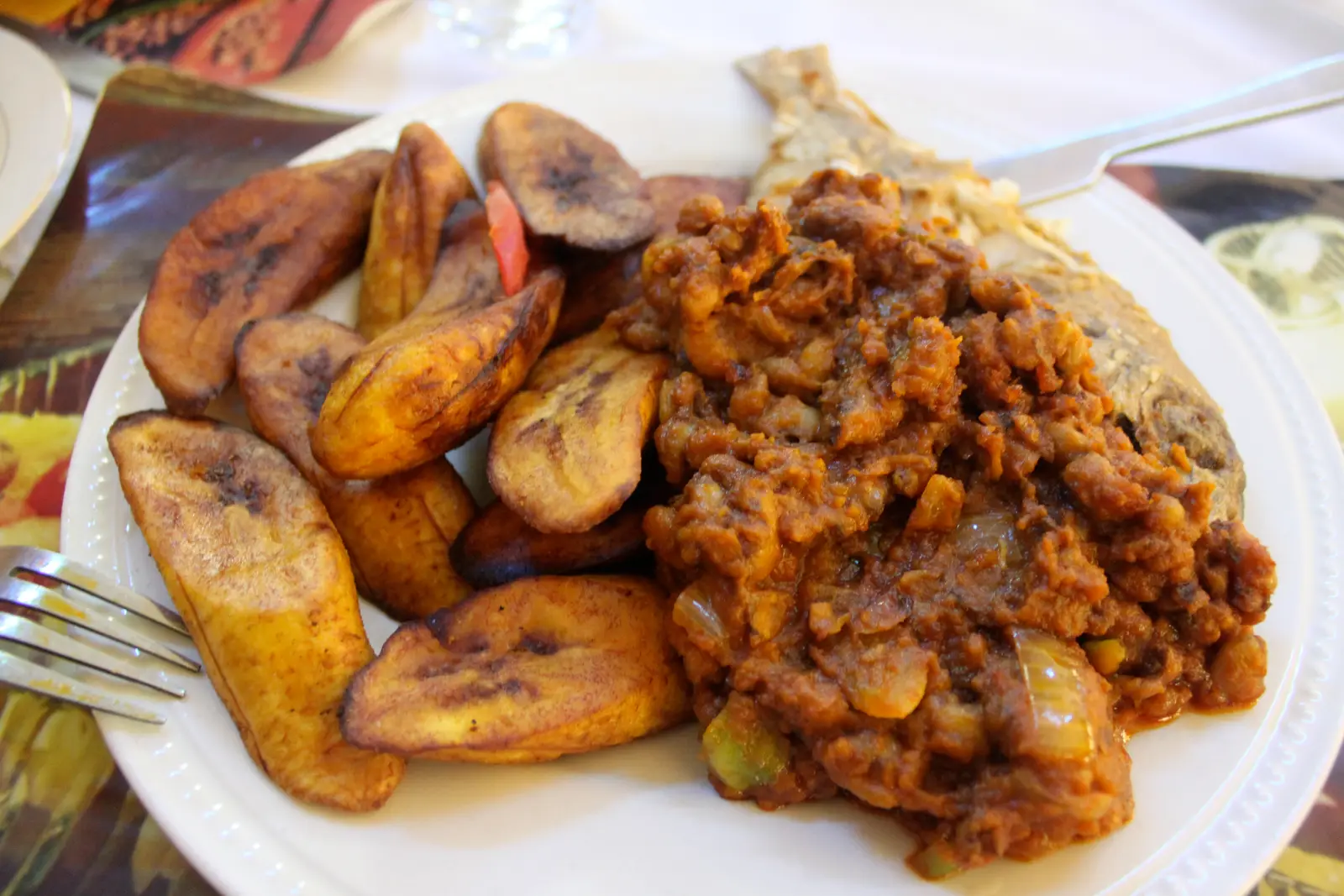
So the dish is not a Southern invention that happens to use African ingredients. It is a West African way of cooking rice, in a liquid made savory by something else in the pot, carried to the Carolinas and built out of what was there. Across West Africa the same logic produces jollof, waakye, and dishes like the Ghanaian red-red above. It belongs to a family, and it has cousins all over the Atlantic.
The earliest printed recipe most people point to is in The Carolina Housewife, published anonymously in 1847 by Sarah Rutledge, "a Lady of Charleston." It is three ingredients: one pound of bacon, one pint of red peas, one pint of rice. The dish is referenced earlier still, in Recollections of a Southern Matron in 1838, where "Hopping John" is glossed simply as bacon and rice.
That is worth sitting with. The recipe did not change much in two centuries because it did not need to.
The rice itself has a history as specific as the dish. Carolina Gold was the long-grain variety that made the Lowcountry rich, grown on tidal plantations in a system that required enormous skilled labor and enormous cruelty to maintain. The variety was effectively lost in the twentieth century after the rice economy collapsed, then recovered decades later from seed stock and brought back into cultivation. You can buy it now. It is noticeably better than supermarket long-grain for this dish, nuttier and firmer, and it is also the closest you will get to what the 1847 recipe was describing.
None of that makes hoppin' john a special-occasion dish. It was food for people who had peas, rice and a piece of cheap pork, which is the condition under which most of the world's best dishes were invented.
Nobody agrees on the name
This is the part where most articles pick a story and state it confidently. Don't trust those.
The theories include a corruption of pois pigeons, French for pigeon peas; a French Creole origin by way of Louisiana; a man named John who sold the dish; a tradition of hopping around the table before eating; and a few more. Coastal Review has run through the main candidates without landing on one, which is the honest position.
The etymology is unresolved. Anyone telling you otherwise is choosing the version they like best.
The traditional recipe
This is the method as it is traditionally made, not an original development. Quantities follow the proportions that have been standard since Rutledge: roughly equal volumes of peas and rice.
Ingredients
- 1 cup dried black-eyed peas or red cowpeas
- 4 oz smoked pork: bacon, salt pork, or a ham hock
- 1 medium onion, diced
- 1 celery rib, diced
- 1 cup long-grain white rice
- 4 cups water or stock
- Bay leaf, black pepper, salt
- Optional: a dried chili, a splash of vinegar or hot sauce at the end
Method
- Soak the peas several hours or overnight. Cowpeas cook faster than most dried beans, so an overnight soak is a convenience rather than a requirement.
- Render the pork in a heavy pot over medium heat until it gives up its fat. Add the onion and celery and cook until soft.
- Add the drained peas, the water or stock, and the bay leaf. Simmer gently, uncovered, until the peas are tender but still hold their shape, usually 45 minutes to an hour. Do not boil them hard; they break.
- Measure the liquid. You want about two cups left in the pot. Add water if short, pour some off if long. This is the step that decides whether the dish works.
- Stir in the rice, cover, and cook on low for about 20 minutes, until the rice has absorbed the liquid.
- Rest it off the heat, covered, for 10 minutes. Then fork it apart, season, and finish with vinegar or hot sauce.
Two technical notes worth adding as a cook, both about seasoning and both about the same principle.
Salt the peas properly while they simmer, not at the end. The rice seasons itself from the liquid it absorbs, so if the pea liquor is bland the rice will be bland, and no amount of salt at the table will fix it. You are not seasoning a pot of beans. You are seasoning the cooking medium for a pot of rice, which is a different job and needs a heavier hand.
And resist the urge to stir once the rice is in. Rice releases starch when you agitate it, and the whole appeal here is distinct grains carrying the flavor of the pork, not a porridge. Lid on, low heat, leave it alone, and do the forking at the very end. The old advice about not lifting the lid is not superstition in this case; the dish is cooking in trapped steam, and every peek costs you some of it.
What goes with it, and why
Collard greens and cornbread, and the symbolism is not subtle. The peas are coins, the greens are folded paper money, and the cornbread is gold. The whole plate is a wish about money, which is also true of what each New Year's dish is supposed to buy in most other countries that bother with the custom.
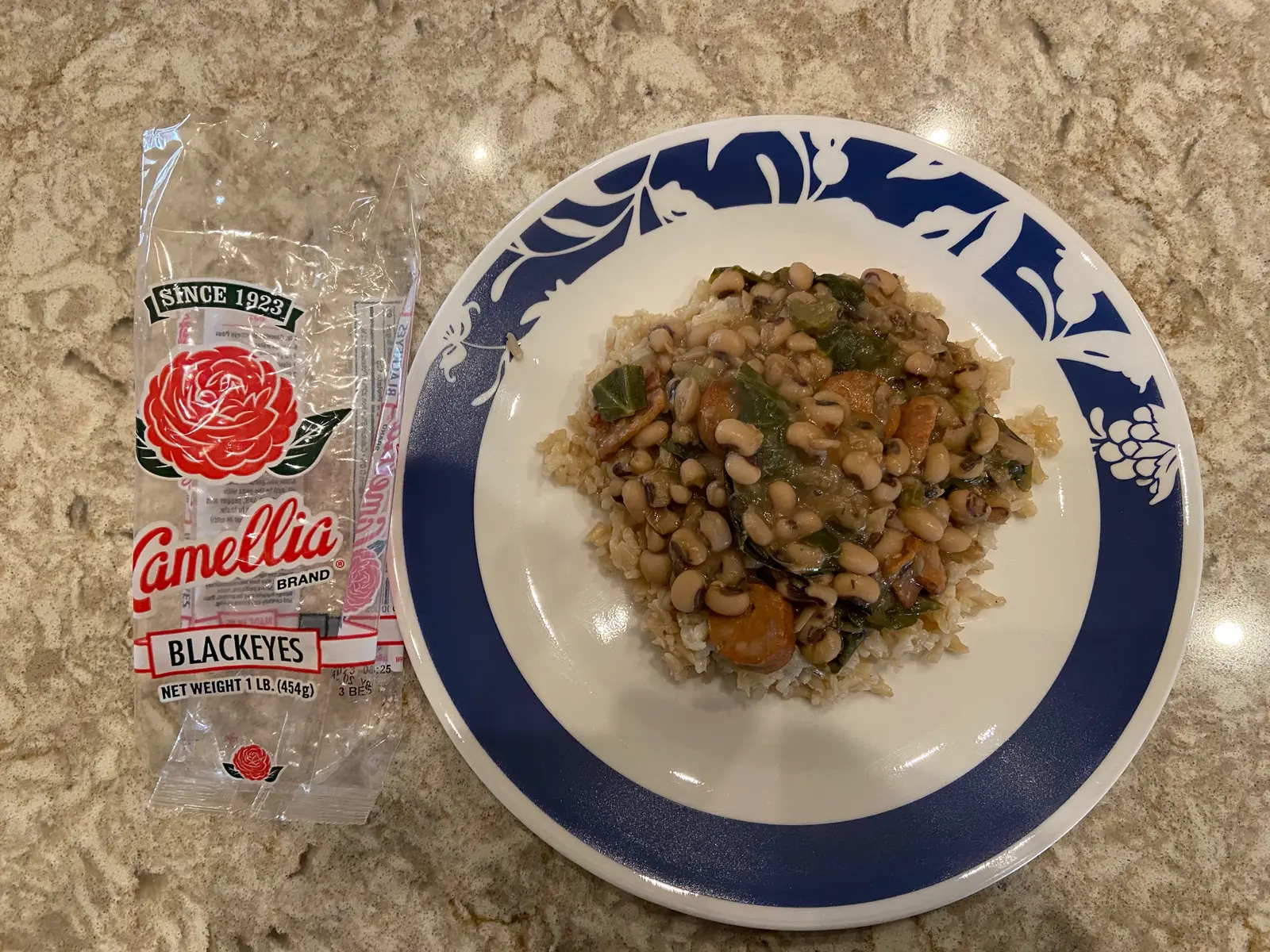
There is also a name for the leftovers. Eaten on January 2nd, the dish becomes Skippin' Jenny, and finishing it is supposed to demonstrate the frugality that earns you the luck in the first place. It is a nice piece of folklore and it is also just a sensible attitude toward a pot of beans.
The same pot, a different island
I grew up in New York in a Colombian family, on a block that was mostly Puerto Rican. The dish I know in my body is not hoppin' john. It is rice cooked with pigeon peas, arroz con gandules, made in a heavy pot with a piece of pork in it, the rice taking its color and its salt from the liquid underneath.
Which is to say: the same dish. Different island, different pea, same idea.
That is not a coincidence or a cute parallel. Rice and a field pea cooked together in a seasoned liquid, with cured pork for depth, is one of the most widely distributed techniques in the Atlantic world, because the people who carried it were distributed by force along the same routes. Jamaican rice and peas. Cuban moros y cristianos. Brazilian baião de dois. Hoppin' john. Arroz con gandules. The names are local. The method is not.
Most of what gets filed under regional American cooking has a story like this underneath it, if anyone looks. Hoppin' john just happens to have kept better records than most.
FAQ
What is hoppin' john?
A Lowcountry dish of field peas and rice cooked together with smoked pork, traditionally eaten in the American South on New Year's Day for good luck. The peas represent coins. It is usually served with collard greens and cornbread.
What peas are used in hoppin' john?
Black-eyed peas today, but the older Charleston versions used red cowpeas, a smaller and earthier field pea. Both are cowpeas and both originate in Africa. The earliest printed recipe, in The Carolina Housewife of 1847, specifies red peas.
Why is it called hoppin' john?
Nobody knows. The leading theories include a corruption of the French pois pigeons (pigeon peas), a French Creole origin by way of Louisiana, and a vendor named John. None is settled, and sources that state one confidently are picking a favorite.
Do you cook the rice separately?
No, and this is the main thing people get wrong. The rice is cooked in the liquid the peas simmered in, so it absorbs the smoke and salt from the pork. Rice boiled in water with peas spooned over it is a different, lesser dish.
What is Skippin' Jenny?
The name for hoppin' john leftovers eaten on January 2nd. Finishing the pot is said to show the thrift that earns the year's good fortune.
A pot of peas and rice is not a luck charm. It is a technique that crossed an ocean against the will of the people carrying it, and then outlasted everyone involved.