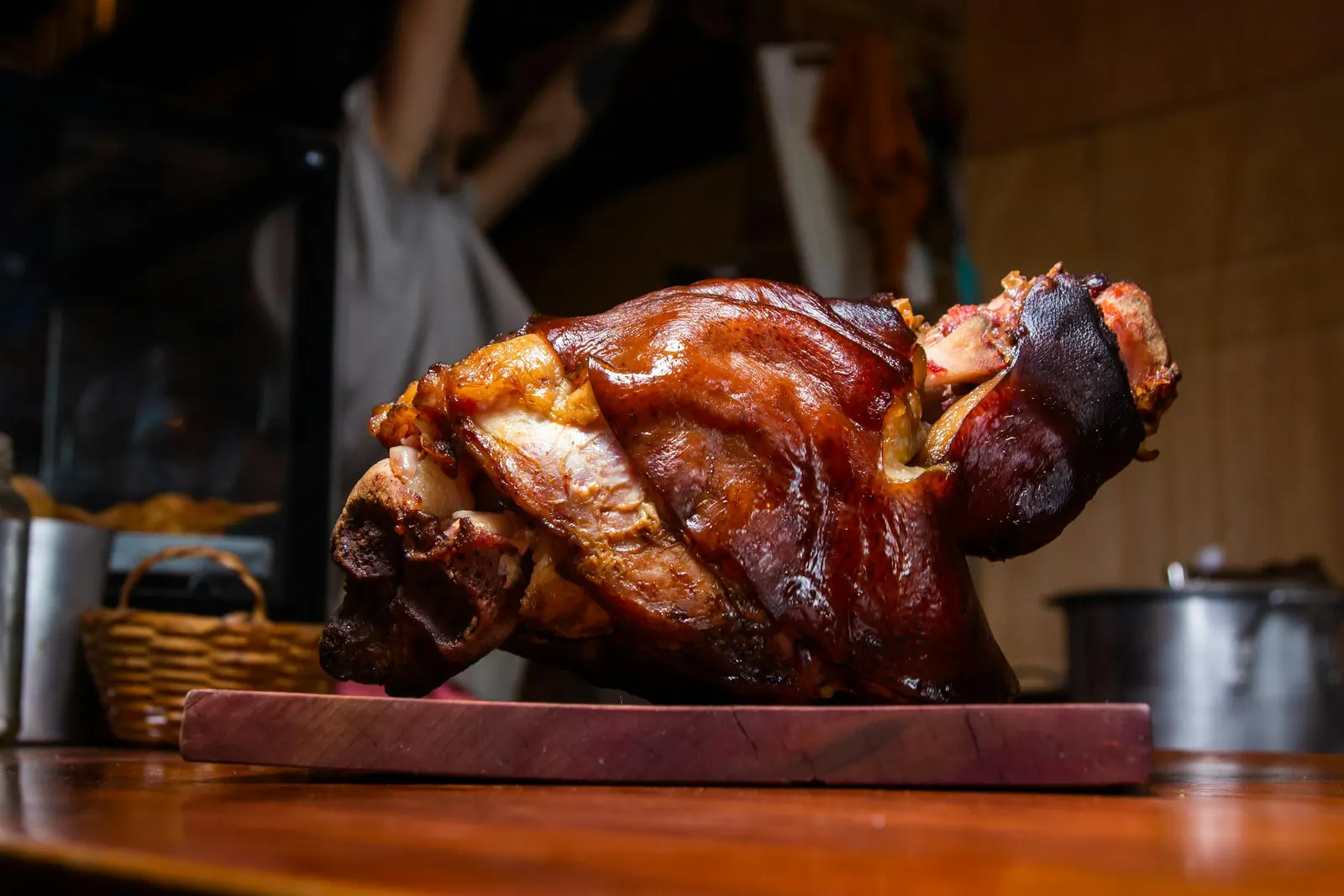
Pernil is Puerto Rico's roast pork, and it is the most everyday member of the lechón family. A pernil is a pork shoulder or leg, scored, marinated hard with a paste of garlic, oregano, salt, and adobo, then roasted low and slow for hours until the meat is tender enough to pull apart and the skin on top has crisped into crackling. Where a whole roast pig demands a spit, a fire, and a crowd, a pernil fits in a home oven. That is why it became the roast pork that Puerto Rican families actually make, and why it anchors the most important meal of their year.
What pernil is
The word pernil refers to the cut: in Spanish it names the leg or shoulder of the pig. In Puerto Rican cooking, pernil almost always means a bone-in pork shoulder, sometimes the fresh ham, roasted whole as a single piece.
That choice of cut is what separates pernil from the rest of the lechón family. The Philippines and Colombia roast the entire animal. Spain roasts a whole milk-fed piglet. Puerto Rico, for the home version, took one large, forgiving, well-marbled cut and treated it with the same respect. A pork shoulder has enough fat and connective tissue to survive a long roast and come out moist, which makes it the ideal cut for a slow oven and a cook who cannot tend a fire all day. The same forgiving quality is what lets the cut turn silky when it is slow-cooked in fat as pork confit.
The marinade: garlic and adobo
A pernil is built on its marinade. The base is a wet garlic paste, often a great deal of garlic, mashed with oregano, salt, pepper, and adobo, the all-purpose Puerto Rican seasoning blend. Many cooks add sazón, a splash of olive oil, and an acidic element such as sour orange or another citrus.
The shoulder is scored deeply, sometimes with the skin loosened, and the paste is pushed into every cut so the seasoning reaches the inside of the meat rather than just sitting on the surface. Then it rests, ideally overnight and often longer. That long marinade is not optional in the way home cooks sometimes treat it. It is the step that makes a pernil taste like a pernil. The citrus in the marinade does what acid always does to pork, brightening it and cutting the richness, the same balancing act covered in the role of acid in food.
The cuerito: getting the skin right
The other half of a great pernil is the cuerito, the skin. A properly roasted pernil has a sheet of skin on top that has rendered and crisped into hard, shattering crackling, and at a family gathering it is fought over the same way lechón skin is everywhere else.
Getting there takes patience and a two-phase roast. The pork goes in low and slow for hours, often skin-loosely-covered or simply at gentle heat, so the shoulder cooks through and the collagen breaks down. Then, near the end, the heat is pushed high so the skin blisters and crisps without the meat below drying out. A pernil pulled too early has soft, rubbery skin, and to a Puerto Rican cook that is a real failure of the dish.
Pernil and the Puerto Rican Christmas
Pernil is occasion food, and on the island its occasion is Christmas. The Puerto Rican Nochebuena, the Christmas Eve celebration, is built around a pernil, typically served with arroz con gandules, the rice cooked with pigeon peas that is its near-inseparable partner, and often pasteles, the dense holiday parcels of mashed root vegetable and pork.
This is the same role lechón plays everywhere it exists. In the Philippines it is the fiesta. In Colombia it is the San Pedro festival and the Sunday market. In Puerto Rico it is the long Christmas season, and the smell of a pernil in the oven is, for a lot of people, the smell of December.
A pernil Thanksgiving
In my family, growing up, Thanksgiving was a pernil. There was no turkey. The centerpiece was a garlic-adobo pork shoulder, roasted the way it would be for Nochebuena, and that was the holiday roast.
What I find telling, looking back, is what stayed. We kept the American Thanksgiving sides, the candied yams, the pumpkin pie, the whole supporting cast of the holiday. We just swapped the bird in the middle for the roast our family actually wanted to eat. That is how immigrant tables tend to work. The frame of the new country stays and the heart of the plate stays your own, and a pernil in place of a turkey is about as clear an example of that as I can give. It is also one of the few dishes where I tell anyone learning to cook without recipes to follow the recipe anyway. Some dishes have been refined over generations, and the home version is meant to land in a very specific place.
Pernil and the whole-pig lechón
It is worth being precise about the words, because Puerto Rico uses two. A whole pig roasted on a spit over wood is lechón asado, the pride of the island's roadside lechoneras, and it is a close cousin of Filipino lechón, the whole spit-roasted pig. Pernil is the shoulder version, the one scaled down to a home oven.
Both sit inside the same family. Spanish cochinillo kept the dish small and pure, Colombian lechona packed it with rice, and Puerto Rico kept a whole-pig tradition alive while also making a home-sized roast that any family could pull off. One Spanish word, lechón, and at the Puerto Rican Christmas table it points at both the spit-roasted pig and the shoulder in the oven.
FAQ
What is pernil?
Pernil is a Puerto Rican dish of roast pork: a bone-in pork shoulder or leg, marinated with garlic, oregano, and adobo, then slow-roasted for hours until the meat is tender and the skin has crisped into crackling.
What is the difference between pernil and lechón?
In Puerto Rico, lechón asado is a whole pig roasted on a spit, while pernil is a single pork shoulder or leg roasted in an oven. Both are roast pork for a celebration, and both belong to the broader lechón family, but pernil is the version most families cook at home.
What is pernil served with?
The classic pairing is arroz con gandules, rice cooked with pigeon peas. A Puerto Rican holiday table will often also include pasteles, the dense parcels of mashed root vegetable and pork.
Why is pernil eaten at Christmas?
Pernil is the centerpiece of the Puerto Rican Nochebuena, the Christmas Eve celebration. Like roast pig across the Spanish-speaking world, it is occasion food, and Christmas is the largest occasion of the year.
How long does pernil take to cook?
A pernil is a slow roast. A bone-in shoulder typically needs several hours at low heat so the meat becomes tender, followed by a short blast of high heat at the end to crisp the skin. Cooks also marinate it well ahead, ideally overnight, before it ever goes in the oven.