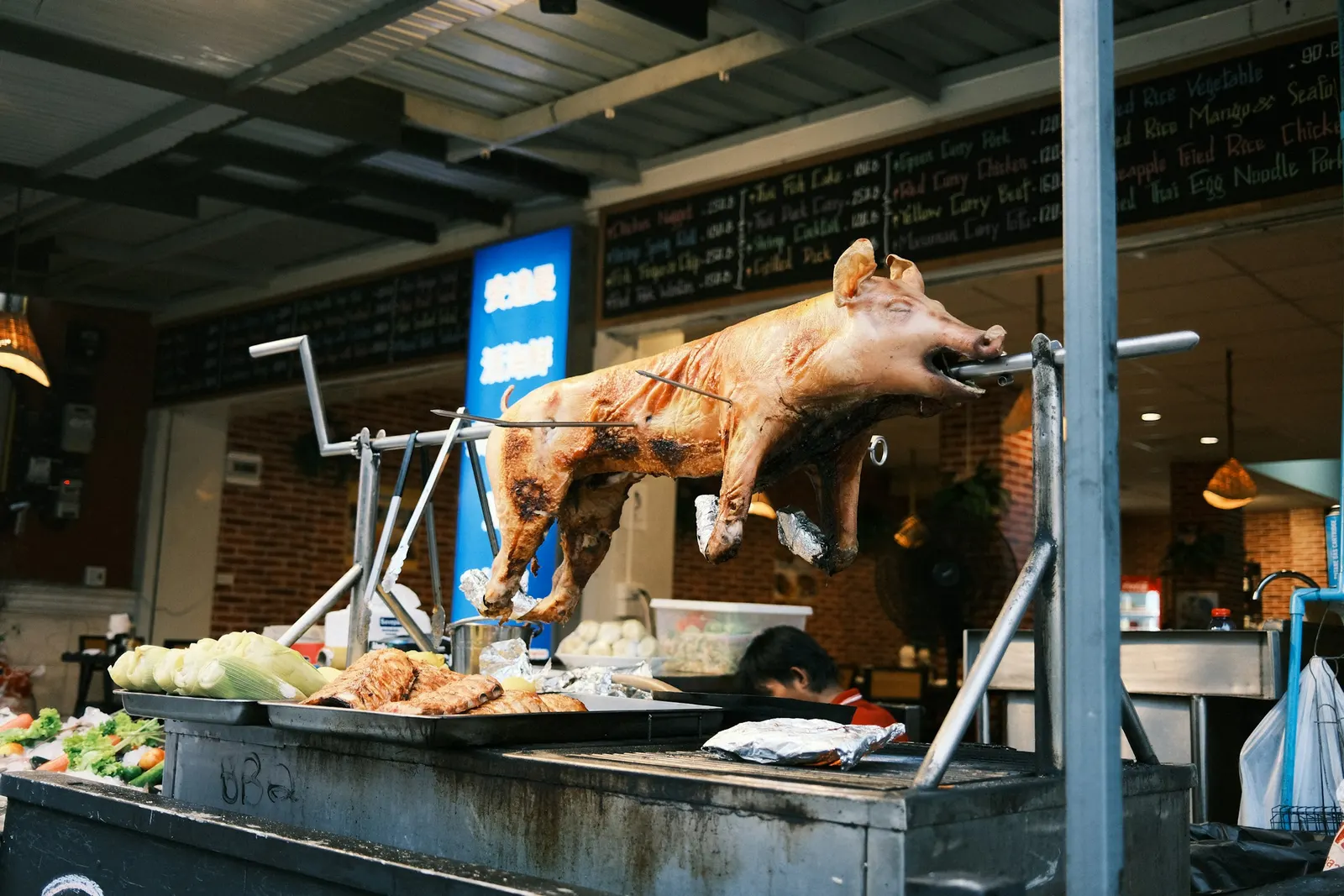
Lechón is the roast pig of the Spanish-speaking world. The word itself is Spanish for a suckling pig, a piglet still young enough to be feeding on milk, and over four centuries it spread along the routes of the Spanish empire and put down roots on three continents. Today "lechón" does not name one dish. It names a family of them. In the Philippines it is a whole pig turned over coals until the skin shatters. In Colombia it is lechona, a pig deboned and packed with rice. In Spain the closest relative is cochinillo, the roast suckling pig of Castile. In Puerto Rico it is pernil, a slow-roasted pork shoulder, and a whole pig on a spit is lechón asado. This is a guide to the whole family, and where to read about each member in depth.
Where the word comes from
Lechón comes from leche, the Spanish word for milk. A lechón is, strictly, a piglet still nursing, slaughtered young, before it has been weaned onto solid feed. The meat of a milk-fed pig is pale, tender, and mild, and the animal is small enough to roast whole over a fire. That is the original, narrow meaning, and it is the meaning Spain still holds closest to.
But words travel faster than definitions. As Spanish spread across the Caribbean, the Pacific, and South America, lechón loosened. In most places it stopped meaning specifically a suckling pig and came to mean the roast pig itself, at whatever size, prepared however the local kitchen prepared it. The name stayed fixed while the dish underneath it changed completely. That gap, one word over four very different plates, is the whole story of lechón.
One word, four dishes
The four best-known members of the lechón family share a name and an occasion. They share almost nothing else.
Filipino lechón
In the Philippines, a former Spanish colony, lechón kept the most literal form: a whole pig, spitted end to end and turned slowly over charcoal for hours until the skin becomes a brittle, glassy crackling. It is the unmistakable centerpiece of a Filipino fiesta, the dish a celebration is built around. The skin is the prize, and the whole roast is carved at the table or chopped on a board. Read the full account in the whole roast pig of every Filipino fiesta.
Colombian lechona
Colombia took the word in a different direction. Lechona, the signature dish of the Tolima region, is a pig that has been deboned, then stuffed with a filling of rice, yellow peas, and seasoned pork, and roasted for many hours until the skin crisps and the inside cooks into a single dense, savory mass. It is sold by weight from market stalls, served with a small piece of crackling and a starchy arepa, and it is a dish Colombians travel for.
Spanish cochinillo
Spain mostly kept the strict definition and changed the name. The famous roast suckling pig of Castile, especially Segovia, is called cochinillo, or cochinillo asado. It is a very young milk-fed piglet, roasted in a wood oven until the skin is thin and crisp and the meat nearly falls apart. The Segovian tradition of carving it with the edge of a plate, to prove how tender it is, is its best-known piece of theater.
Puerto Rican pernil
In Puerto Rico, the word splits. A whole pig roasted on a spit is lechón asado, the pride of the lechoneras along the mountain roads. But the version that lands on most home tables, especially at Christmas, is pernil: a pork shoulder marinated hard with garlic, adobo, and citrus, then slow-roasted until the cuerito, the skin, crackles on top of meat that pulls apart with a fork.
What the four have in common
Set the four dishes side by side and the recipe connecting them disappears. A whole spit pig, a rice-stuffed pig, a tiny oven-roasted piglet, and a marinated shoulder are not variations on a method. They are four separate techniques.
What survives across all four is the role the dish plays. Lechón, in every country that uses the word, is occasion food. Nobody roasts a whole pig, or stuffs one with rice, or marinates a shoulder for two days, for an ordinary dinner. It is the food of Christmas, of a town fiesta, of a baptism or a wedding, of the Sunday when the whole family is coming. It takes a long time, it feeds a crowd, and it is meant to be the thing everyone gathers around. The roast pig is the visual center of the table, the way a turkey is at an American Thanksgiving.
The other constant is the skin. Whatever the cut, whatever the country, the cook is chasing the same thing: a pork skin rendered and roasted until it stops being soft and turns to crackling. The Filipino carver, the Tolima market vendor, the Segovian asador, and the Puerto Rican cook in front of the oven are all listening for the same crisp sound. That is the through line. The pantry around it is local, but the goal is identical.
How the dish localized
Lechón is one of the clearest examples of how a food travels. The Spanish empire carried pigs, the Catholic feast calendar, and the word lechón across the world. What it did not carry was a single fixed recipe. Each place that received the word already had its own fire, its own grains, its own way of seasoning, and its own idea of a feast.
So the Philippines, with its tradition of spit-roasting over charcoal, made lechón a whole pig on a pole. Tolima, a Colombian rice-and-pork region, made it a vehicle for stuffing. Castile, with its bread-oven culture and its prized milk-fed piglets, kept it small and pure. Puerto Rico, where the pork shoulder is an everyday cut, made the feast version a marinated pernil. The word was the seed. The local kitchen was the soil. (The same pattern shaped Spanish cured pork, where one tradition split into many: see the last of the bone-in hams.)
This is also why "which country does lechón best" is not a real question. They are not competing versions of one dish. They are four different dishes that happen to share a Spanish name and a reason to exist.
FAQ
What does the word lechón mean?
Lechón is Spanish for a suckling pig, a piglet young enough to still be nursing. The word comes from leche, milk. Spain holds closest to that strict meaning. In most of the Spanish-speaking world the word loosened over time and came to mean the roast pig itself, at any size.
Is lechón the same as cochinillo?
They overlap but are not identical. Cochinillo specifically means a roast suckling pig, and it is the word used in Spain, especially in Segovia. Lechón is the broader term used across Latin America and the Philippines, and it often refers to a full-grown roast pig rather than a milk-fed piglet.
What is the difference between lechón and lechona?
In Colombia, lechona (the feminine form) names a specific dish: a deboned pig stuffed with rice, yellow peas, and seasoned pork, then roasted whole. Filipino lechón is a whole pig with nothing inside it, roasted on a spit. Same root word, two completely different preparations.
Is pernil a kind of lechón?
Pernil is part of the same family. In Puerto Rico, a whole spit-roasted pig is lechón asado, while pernil is the roast pork shoulder version that most families make at home. Both are roast pork for a celebration, and the two words are often used around the same Christmas table.
Why is lechón eaten at Christmas?
Lechón is occasion food everywhere it exists, and Christmas is the largest occasion on the calendar in Catholic, formerly Spanish countries. A whole roast pig is expensive, slow, and made for a crowd, which makes it the natural centerpiece for the biggest gathering of the year. In the Philippines, Colombia, and Puerto Rico alike, the holiday table is built around it.