
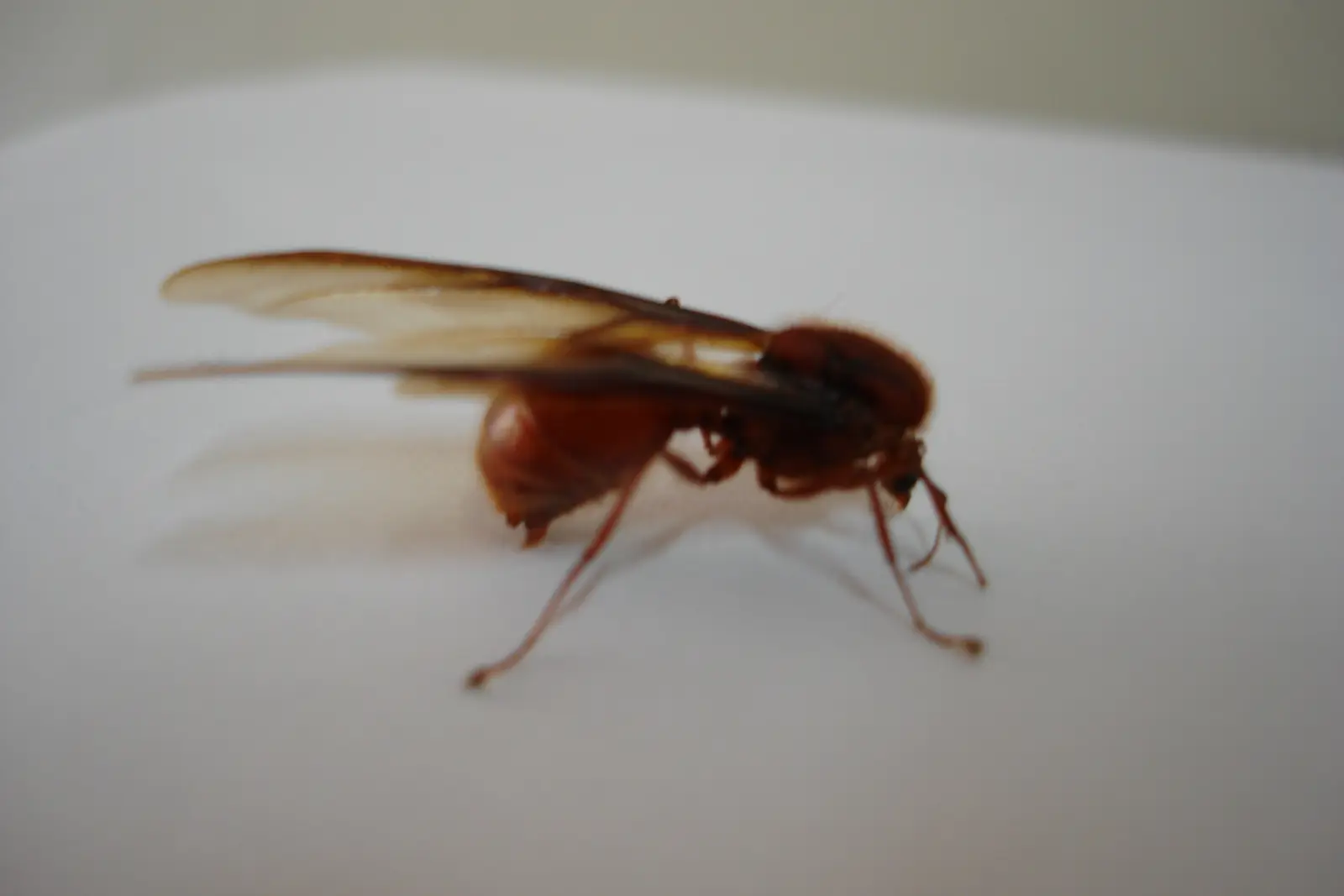
Hormigas culonas are large winged queen ants, Atta laevigata, that are toasted with salt and eaten as a snack in the Colombian department of Santander. The name translates, without much delicacy, to "big-bottomed ants." They are harvested for a few weeks a year when the queens leave the nest to mate, sold in paper bags at roadside stands and bus terminals, and eaten by the handful like peanuts. They taste nutty and faintly smoky, somewhere between a burnt peanut and popcorn, with a shell that cracks and a slightly bitter finish.
That is the whole thing, honestly. The strangeness is entirely on the visitor's side.
What hormigas culonas actually are
They are not the ants running across a kitchen counter. Atta laevigata is a leafcutter, a genus that farms fungus underground on a scale that dwarfs most human agriculture, and the ants that get eaten are the reproductive females — the queens, fattened with the fat reserves they will need to start a colony of their own.
That fat is the point. The abdomen is swollen, pale, and dense, which is what makes the queen worth eating and the worker worthless. It is also what gives the ant its unlovely Spanish nickname.
Once a year, usually after the first heavy rains between March and May, the winged queens fly. Whole colonies release them at once. This is when they are caught, by hand, in the fields around Barichara, San Gil, and the countryside outside Bucaramanga. The window is short, a matter of weeks, and it moves with the weather rather than the calendar. A bad rainy season is a bad ant season, and the price in the market reflects it.
What they taste like
Descriptions vary, and most of them reach for something familiar. Burnt peanut is the most common. Popcorn, particularly the scorched kernels at the bottom of the bowl, is the second. People who eat a lot of them tend to land on something closer to bacon fat, which comes from the rendering that happens when a fatty abdomen hits a hot surface.
The texture is the part nobody predicts. There is a distinct crack, like a pumpkin seed, and then almost nothing inside — the abdomen collapses into a small amount of rich, slightly greasy paste. The aftertaste is where it gets divisive. There is a bitterness at the end, mineral and green, that some people never get past and others stop noticing after the third one.
Salt does the heavy lifting, as it does with every snack humans have ever made shelf-stable over a fire.
How they are prepared
The traditional method is simple enough that it has not needed improving.
- The queens are caught alive and the wings and legs are pulled off, leaving the head, thorax, and the fat abdomen.
- They are soaked in salted water, which seasons them and kills them.
- They are toasted in a clay pot, a callana, set over a wood fire, and stirred until the shells darken and go brittle.
- They cool, and they are packed into bags or tins.
Done properly they keep for months, which is the entire reason the technique exists. A food that appears for three weeks a year is only useful if you can hold onto it. Toasting and salting is preservation first and flavor second, the same bargain behind the long curing of a bone-in ham, salt cod, and every dried chile in Mexico.
Why Santander and almost nowhere else
The practice predates Colombia. The Guane, who lived in what is now Santander before the Spanish arrived, ate the ants and passed the habit to everyone who came after, which is why the tradition is regional rather than national. Plenty of Colombians from Bogotá or the coast have never eaten one and would rather not. The country splits along these lines constantly, which is the same reason there is no single Colombian breakfast either.
Two pieces of folklore travel with them. The first is that they are an aphrodisiac, which is asserted confidently across Santander and has no evidence behind it beyond the enthusiasm of the people selling them, in roughly the way aguardiente is credited with powers no sugarcane spirit has ever had. The second is that bags of hormigas culonas are given to newlyweds as a wedding gift, a custom tied directly to the first belief and to the fact that the ants are, biologically, the fertile members of the colony about to go start a family. Whether or not the aphrodisiac claim holds, the symbolism is hard to argue with.
They are now exported, sold in tourist shops, and dipped in chocolate for people who need the idea softened. The chocolate versions are a fair introduction and a poor representation.
The rest of the world has been eating insects all along
The reflex that treats this as bizarre is a local reflex, not a universal one. The FAO's 2013 report on edible insects documented more than 1,900 species eaten by humans, with beetles and caterpillars making up roughly half of what gets consumed. The report's widely repeated claim that two billion people eat insects has since been challenged as an overestimate by researchers in the field, and that criticism is worth honoring — but the direction of the number is not in dispute. Insect eating is ordinary across most of the tropics.
A short tour of what that looks like:
- Chapulines, Oaxaca. Grasshoppers toasted with garlic, lime, and chile, sold by the cup in the markets and folded into tacos and quesadillas. Probably the most accessible entry point for an American.
- Escamoles, central Mexico. The larvae of Liometopum ants, harvested from agave roots, sautéed in butter. Sometimes called Mexican caviar, mostly by people trying to sell it, and genuinely delicate — closer to a soft scrambled egg than to anything you would expect.
- Mopane worms, southern Africa. The caterpillar of the emperor moth, dried and rehydrated into stews across Zimbabwe, Botswana, and South Africa. A staple protein, not a novelty.
- Beondegi, Korea. Silkworm pupae simmered and sold hot from carts, and canned in every supermarket. The smell arrives before the cart does.
- Inago, Japan. Rice-field grasshoppers simmered in soy and sugar as tsukudani, a preserved side dish from the mountain provinces.
- Fried crickets, silkworms, and water beetles across Thailand, Cambodia, and Laos, sold from carts by the bag with a shake of seasoning.
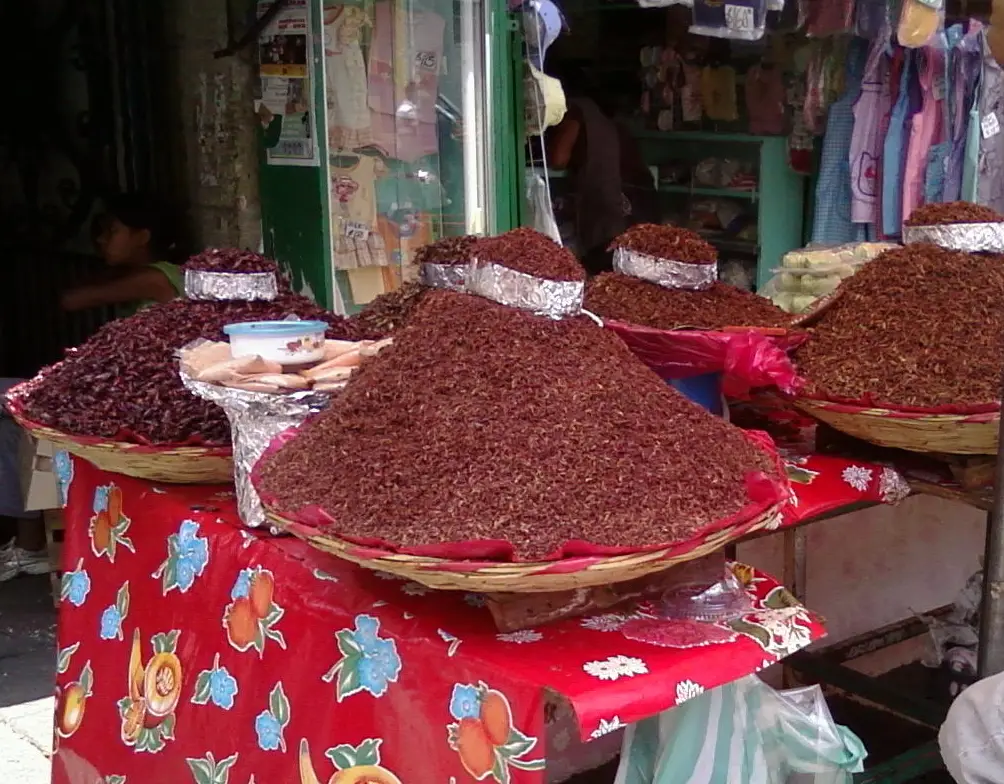
What connects these is not desperation. Every one of them is seasonal, regional, and treated as a good thing to eat rather than a last resort. Chapulines are more expensive per pound than a lot of meat in Oaxaca. Hormigas culonas cost more than beef in Santander during a thin year. These are delicacies with price tags to match, which is the opposite of the survival-food framing they usually get in the American press.
The West already eats insects, just quietly
The disgust is also less consistent than it looks.
Carmine, also labeled cochineal or E120, is a red dye made from the crushed bodies of Dactylopius coccus, a scale insect farmed on cactus. It has colored food, drink, and cosmetics for centuries and still shows up in yogurt, candy, and juice. Shellac, sold on ingredient lists as confectioner's glaze, is a resin secreted by the lac bug and is what makes shiny candy shiny.
Then there is the baseline. The FDA publishes a Food Defect Levels Handbook that sets the maximum amount of insect fragments permitted in food before it is considered adulterated, because removing every trace is not achievable at scale. Ground spices, flour, chocolate, canned tomatoes, and peanut butter all carry an allowance. Nobody is being poisoned. It is simply a fact of harvesting plants outdoors.
So the line is not really between people who eat insects and people who do not. It is between people who know they are doing it.
Whether they are actually worth eating
The sustainability case for insect protein is real on paper. Insects convert feed to body mass far more efficiently than cattle, need dramatically less water and land, and produce a fraction of the greenhouse gas per gram of protein. That is the argument the FAO made and it has not been overturned.
The case has been oversold anyway. Western insect farming has spent a decade failing to find a market, and several well-funded cricket-protein companies have folded or pivoted to pet food, which is where most farmed insect protein actually ends up. The obstacle was never nutrition. It was that nobody wants a cricket flour protein bar when a whey one is cheaper and tastes better.
One practical warning that matters more than any of this: if you are allergic to shellfish, be careful. Insects and crustaceans share tropomyosin, the protein responsible for most shellfish allergies, and cross-reactivity is documented. This is not a fringe concern, and it is the one genuine reason to skip the bag.
The honest position is that hormigas culonas are not the future of food and were never trying to be. They are a regional delicacy with a short season, a specific flavor, and about four hundred years of continuity behind them. That is a better reason to eat something than a carbon calculation.
FAQ
What do hormigas culonas taste like?
Nutty and faintly smoky. The most common comparisons are burnt peanuts and scorched popcorn, with a rendered, bacon-like richness from the fat in the abdomen. There is a bitter, mineral finish that divides people. The shell cracks like a pumpkin seed.
When are hormigas culonas harvested?
During the mating flights of the queen ants, which follow the first heavy rains of the year in Santander, generally between March and May. The season lasts a few weeks and shifts with the weather, so it often overlaps with Holy Week but is not fixed to it.
Where can you buy hormigas culonas?
In Colombia they are sold at roadside stands, markets, and bus terminals throughout Santander, especially around Barichara, San Gil, and Bucaramanga. Outside Colombia they turn up in specialty importers and online shops, usually vacuum-packed or chocolate-coated, at a considerable markup.
Are edible insects safe if you have a shellfish allergy?
Not necessarily. Insects and shellfish share tropomyosin, the protein behind most shellfish allergies, and cross-reactions are documented. Anyone with a known crustacean allergy should treat edible insects as a real risk and talk to an allergist first.
Can you bring hormigas culonas into the United States?
Processed, thoroughly cooked, commercially packaged insect products are generally treated as food products rather than live agricultural material, but customs decisions are made case by case and live or raw insects are not permitted. Declare them. The penalty for declaring something that turns out to be fine is a conversation; the penalty for not declaring is a fine.
There is a version of this story that treats the ants as a stunt, and it is the version that usually gets written. A brave visitor, a paper bag, a grimace, a punchline.
The people in Barichara are not doing a bit. They are eating a seasonal food their great-grandparents ate, during the few weeks it exists, because it is salty and rich and it tastes like the beginning of the rains.


