The kitchen brigade system is the formalized hierarchy that organizes a professional restaurant kitchen, with each cook assigned to a specific station and a chain of command running from the executive chef down to the dishwasher. It was codified by the French chef Auguste Escoffier in the early 1900s, borrowed from military structure, and at its peak it could include twenty or more named roles. Most modern kitchens no longer run a full Escoffier brigade. What survives is a flattened, working version of it. This is the walk through what the system actually is, what each role does, and what's left of any of it on a real line today.
What the kitchen brigade actually is
The brigade was codified by Auguste Escoffier, the French chef and writer who, between his work at the Savoy in London and the Ritz in Paris, set down a system for organizing the chaos of a large hotel kitchen. Escoffier had served in the French army during the Franco-Prussian War, and the structure he brought to the kitchen was openly military. Stations were squads. The chain of command was literal. Each cook had a single job and a single person to report to. The point was speed, repeatability, and the ability to produce hundreds of plates a night without the line collapsing.
The full brigade at its most elaborate could include more than twenty named roles, each responsible for a specific category of dish or task. In practice, only the largest grand-hotel kitchens of Escoffier's era ever ran a complete brigade. The rest of the trade adopted the parts that fit the size of the kitchen and the volume of the room. That has been true since 1903 and it is more true now.
The roles, top to bottom
What follows is the full brigade as Escoffier laid it out, with a working note on what most of these roles look like today.
Chef de cuisine. The head of the kitchen, responsible for the food, the menu, the line, and the cooks. In most modern kitchens this is the person diners think of as "the chef." Where a single restaurant has only one kitchen, the chef de cuisine is the top of the brigade.
Executive chef. A corporate role above the chef de cuisine. The executive chef runs the food program across multiple kitchens or outlets, sets menus and standards, and is usually less hands-on with the line. In a single-restaurant operation, the chef de cuisine and the executive chef can be the same person. In a hotel with several restaurants, they are not.
Sous chef. The second-in-command, and the person actually running the kitchen most nights. The sous chef manages the line during service, runs prep during the day, handles the schedule, fills in on any station that falls behind, and stands between the chef and the rest of the brigade. In most modern kitchens the sous chef is the most important working position. Everyone above them is mostly off the line. Everyone below them takes direction from them. The day-to-day reality of climbing from sous up to chef is its own subject, covered in the honest case for and against becoming a chef.
Chef de partie. The station chef. Each major part of the kitchen has one, and they run that station and any line cooks under them. The classical brigade had a named chef de partie for every category of dish, each with their own job title.
Saucier. The sauce station. Sauces, sautés, and most of the warm protein dishes. In Escoffier's time the saucier was the most respected line position in the brigade, because sauces were the spine of French cooking and the saucier touched almost every plate. The role still exists in serious fine dining. In most modern American casual restaurants it has been folded into the general sauté station.
Poissonnier. The fish cook. Cuts, portions, and cooks all fish and shellfish. Survives where the menu has enough seafood volume to justify a dedicated station. In most modern kitchens it is merged with the sauté or grill station.
Rôtisseur. The roast cook, responsible for roasted and braised meats. Often combined in modern kitchens with the grill.
Grillardin. The grill station, responsible for grilled meats. In the classical brigade this was distinct from the rôtisseur. Today most kitchens combine the two into a single station called "grill" or "meats."
Friturier. The fry station. In the classical brigade, anything that went into hot fat had its own cook. Today this is almost never a standalone role. Even kitchens with a heavy fried-food program have folded the fryer into another station.
Entremetier. The vegetable, soup, egg, and starch cook. Handled all the supporting components on the plate. Today the role is mostly merged into garde manger, pasta, or the general line.
Garde manger. The cold station. Salads, hors d'oeuvres, charcuterie, cold appetizers, plating cold dishes for service. The garde manger station is one of the most durable in the modern kitchen, because cold work is fundamentally different from hot work and still benefits from being its own area.
Pâtissier. The pastry chef. In any kitchen with a dessert program of real ambition, this is its own parallel brigade with its own hierarchy. Pastry runs on different timing, different tools, and different chemistry. Treating it as its own world has survived because the alternative does not work.
Tournant. The swing cook. Floats between stations as needed, fills in for cooks on their days off, knows every job in the brigade well enough to step in. A good tournant is rare and valuable. The role is mostly informal today, often handled by the sous chef or the strongest line cook on staff.
Commis. A junior cook assigned to a chef de partie to learn that station. Most working line cooks under the chef de partie level are doing what was historically a commis job, whether or not the kitchen uses the word.
Apprenti. The trainee, the lowest culinary rank in the classical brigade. Today this maps to the externs and culinary-school stagiaires that rotate through serious kitchens.
Aboyeur. The expediter, sometimes called the expo in American kitchens. Stands at the pass during service, reads tickets out loud to the line, coordinates the timing of dishes from different stations, and inspects every plate before it goes out. The role is real and indispensable in any kitchen of real volume, though many modern kitchens have the chef de cuisine or sous chef play it rather than naming a dedicated aboyeur.
Plongeur. The dishwasher. In Escoffier's brigade, the lowest-paid position. In the actual working life of a kitchen, one of the most important. A kitchen with a broken dish pit shuts down inside an hour, and any cook who has worked a hot line will tell you the same.
Communard. The staff meal cook. In a large brigade, the cook responsible for feeding the kitchen and floor staff before service. Today the role is almost always informal, with the meal handled by whoever has the lightest prep load that day.
That is the full brigade. Some kitchens still recognize every one of these roles. Most have merged or dropped at least half of them.
I have worked every one of these jobs
I want to be clear before saying anything else about the system. I have worked every job in the brigade.
I started as a prep cook, worked dishwashing, worked the line at every hot station, garde manger, saucier, grill, sauté, fish, meats. I climbed to sous chef, ran kitchens as chef de cuisine, sat as an executive chef over multiple operations. The kitchens were French brasseries with full Escoffier brigades, American casual restaurants, rustic European places, Italian rooms, hotels, and executive dining rooms. The brigade has looked different in every one of them. The lesson, across all of them, is the same. The position is structural, but the work is the work, and you cannot do the work well if you have not done every job below the one you are in.
I will say this plainly. I have had nights as an executive chef where I was washing dishes. The plongeur called out, the line was already in service, the dishes were stacking up faster than the runner could absorb them, and the chef had to put on an apron and clear the pit. That is the job. The position is the title. The job is whatever the kitchen needs at that moment. Anyone who tells you otherwise has not run a kitchen.
The onion prank, and what that brigade taught me
The first thing the brigade does to a new prep cook is haze them. The hazing is mostly affectionate. It is also a real part of how the system absorbs new people and decides who belongs.
I was new at one of the French brasseries, working prep, and they had me cut down a fifty-pound bag of onions for the French onion soup. Anyone who has cut onions in volume knows what fifty pounds does to your eyes. The whole kitchen knew it too. So they told me, with completely straight faces, that the trick was to put a piece of French bread in your mouth while you chopped, and the bread would absorb the fumes, and you would not cry.
I bit down on a piece of baguette and got to work. About ten minutes in, the entire kitchen staff came back to the prep area and stood in a half-circle around me, watching me cry with a piece of bread sticking out of my mouth. They laughed. I laughed. The onions kept getting chopped. That was the day they decided I belonged.
The brigade absorbs new people through small initiations like that one. The hazing is not the point. The point is that you took it well, you kept working, and the next time someone tells you something with a straight face you know to ask first. That is one of the oldest forms of training in the trade, and most real kitchens still do some version of it.
The hardcore guys the brigade produces
The brigade also produces a specific kind of toughness in the people who stay in it for years.
I worked with one cook on sauté who kept a paring knife in his pocket all service. He needed it the way a carpenter needs a tape measure. One night, in the middle of a real push, he reached into his pocket for something else and stabbed himself in the arm with the knife. The blade went into his forearm. He looked down, looked at his station, wrapped something around the cut, and kept cooking. The push was real. He finished service.
I am not romanticizing it. That kind of toughness comes from spending years standing in the same spot in the brigade, taking the punishment, and learning to keep your hands working through whatever is happening at the rest of your body. It is a particular kind of person. Brigade kitchens produce them at a higher rate than almost any other workplace I have been in. The cost on the body is real, and so is the skill. Both things are true.
The pasta station, which is its own world
There is one station I have to mention that does not appear in Escoffier's brigade, because pasta as a daily restaurant program is mostly an Italian-American development that the French brigade does not classify directly.
The pasta station, in a busy Italian restaurant, is one of the most fun places you can work. I have stood at it in a few different Italian rooms over the years and there is nothing in the rest of the brigade that compares. You have fifteen pans going on the burner at once, every one of them a different pasta, every one of them with a different sauce, different timing, different finish. You are draining, tossing, mounting butter, finishing with cheese, plating, garnishing, all in a sequence that loops back on itself every ninety seconds. It is loud, it is repetitive, it is improvisational, and it is, when it goes well, awesome. I have never enjoyed a working station more.
Italian kitchens are their own thing. The brigade chart does not quite fit them. But what they do at the pasta station belongs in any honest conversation about how a real kitchen runs.
What the brigade looks like in 2026
The full Escoffier brigade survives in three places. Serious fine dining, large hotels, and culinary schools that still teach the original structure as theory. Everywhere else, the brigade has flattened.
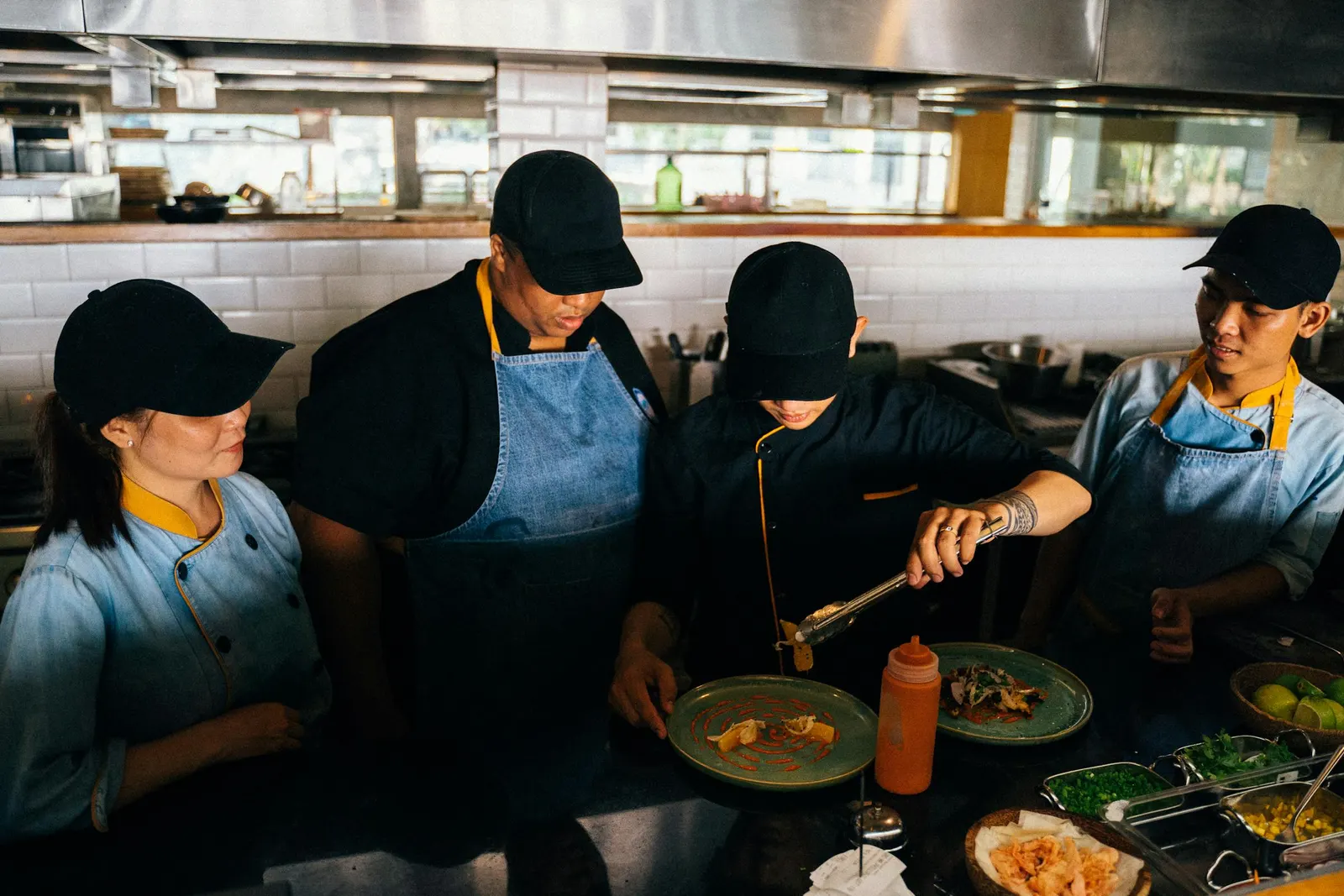
In a modern American casual restaurant, the working version of the brigade is roughly this. A chef running the kitchen, a sous chef running service, three to five line cooks across hot stations (sauté, grill, fry, often pasta or salad), a garde manger or salad station, a pastry person if there is dessert work to do, and a dish pit. Most of the named Escoffier roles have either merged into general "cook" titles or disappeared entirely. The friturier is gone. The poissonnier is folded into sauté. The grillardin and the rôtisseur are one station called "grill." The communard is whoever has time.
In a fine-dining tasting-menu room, the structure is much closer to the original. A chef de cuisine, a sous chef, a chef de partie at each station, a pastry brigade, a dedicated expediter, dedicated commis. The brigade in those rooms is the brigade, in the original Escoffier sense.
In hotels and executive dining operations, there is more of the order back, because the volume and the multiple-outlet structure benefits from it. Not a full Escoffier brigade in most cases, but more rank and more specialization than a single-room restaurant typically needs.
The collapse of the brigade is not a moral failure. It is a labor-cost adjustment, mostly. Twenty named cooks is too expensive for a fifty-seat restaurant. The brigade scales to the room.
Why the best kitchens flatten the brigade anyway
Here is the part of the answer that does not make the culinary-school textbooks. The best kitchens I have worked in, at every level of formality, were not the ones that ran the strictest brigade. They were the ones where everyone knew every station well enough to jump in.
The reason is operational. A kitchen does not break because the saucier cannot make a sauce. It breaks because the saucier has a personal emergency, or the grill went down, or the new hire dropped a pan of pasta and the floor is now slippery and someone has to mop while service is happening. The brigade can handle a single bad night by following the chart. It cannot handle a bad hour inside an otherwise normal service unless people leave their stations and help.
When a kitchen has a strict brigade culture and the people in it have not been cross-trained, every small problem becomes a big one. When a kitchen has the discipline of a brigade and every cook knows the station next to theirs, the small problems get absorbed quietly. That is the difference.
It is also the reason the mise en place of a kitchen matters as much as its hierarchy. The system on paper is a chart of titles. The system in practice is a group of people who have set up their stations well enough that they can also help the person next to them when it goes sideways.
And when the brigade fails to absorb the bad hour, you get the moment everyone in the trade knows. The kitchen falls into the weeds, and no chart on a wall fixes it.
Why the brigade is still the right place to start a career
The contrarian read on the brigade is incomplete without saying this last part.
If you are starting out in the trade, find a kitchen that runs a real brigade and work in it for a few years. The reason is simple. The brigade teaches you to do one job well for a long time. You will spend a year as a commis on the garde manger station and you will leave that year knowing more about cold work than a rotation program would have taught you in five. You will spend the next year on saucier and you will own the sauces in a way that someone who jumped around will not. The brigade builds depth.
The catch is the second half of the same sentence. The brigade is the right place to start. It is not the right place to stay forever. The cooks I have seen who stayed on a single station for ten years, and never asked to learn the one next to them, plateaued. They became the best in the kitchen at their one thing and the worst at moving up. The end game of a career in this trade is to grow, and growth means making the deliberate decision, every couple of years, to learn the next station. The brigade is the school. The career is what you do after.
Pay your dues. Learn the discipline. Move up the ladder. Do not let the position go to your head when you climb, because the night the dishwasher does not show up, you will be the one in the apron at the pit, and that is the job.
FAQ
What is the kitchen brigade system?
The kitchen brigade system is the formalized hierarchy that organizes a professional restaurant kitchen, with named roles for each station and a clear chain of command from the executive chef down to the dishwasher. It was codified by Auguste Escoffier in the early 1900s, modeled on his experience in the French military, and is the structural framework that most professional kitchens still inherit from in some form.
Who created the kitchen brigade system?
The French chef Auguste Escoffier formalized the kitchen brigade in the early 1900s, drawing on his earlier service in the French army. He laid the system out most fully in his 1903 book Le Guide Culinaire. Earlier French kitchens had used informal versions of a brigade structure for centuries. Escoffier turned it into a clear, replicable model that the rest of the trade adopted.
What are the main roles in a kitchen brigade?
The core roles are the chef de cuisine (head of the kitchen), the sous chef (second in command), the chef de partie at each station (saucier, poissonnier, rôtisseur, grillardin, entremetier, garde manger, pâtissier), the tournant (swing cook), the commis (junior cook), the aboyeur (expediter), and the plongeur (dishwasher). The full classical brigade includes more than twenty named positions, most of which have been merged or dropped in modern kitchens.
Do restaurants still use the kitchen brigade today?
Yes, but most run a collapsed version. Serious fine dining and large hotel kitchens still run something close to a full Escoffier brigade. American casual restaurants typically run a flattened version with a chef, a sous chef, a small group of line cooks across hot stations, a garde manger, a pastry person, and a dish pit. The original brigade scales down with the size of the kitchen.
What is the difference between a chef de cuisine and an executive chef?
The chef de cuisine runs a single kitchen day-to-day, from menu to line to staff. The executive chef is a corporate role above the chef de cuisine, overseeing multiple kitchens or outlets, setting menus and standards across them, and typically less hands-on with day-to-day service. In a single-restaurant operation the two roles are often held by the same person. In a hotel or restaurant group, they are not.