Corporate dining vs restaurant work: I left the first for the second more than twenty years ago, and I regret it. The trade-off I thought I was making at twenty-three wasn't the trade-off I actually made. This is the piece I wish someone had handed me when I was offered a steady job in an executive dining room and decided I needed to chase Anthony Bourdain instead.
How I ended up in corporate dining at 30 Rock
I went to culinary school in the early 2000s. The internship the school placed me in was the luckiest first job a young cook could have gotten: corporate dining at 30 Rockefeller Plaza, cooking for the top executives at NBC.
The work day-to-day was catering, dining-room service, and event prep, all on the executive floor. Cheese plates and fruit plates for morning meetings. Sit-down lunches for senior leadership. Buffet setups for events. We cooked for executives, on-air talent, the occasional Saturday Night Live crew between sketches. Everything was planned days in advance. There were no surprises. The kitchen was organized, well-equipped, and run like a real corporate operation, because that's what it was.
After I graduated, NBC hired me. I'd worked the internship hard and they liked the way I cooked. I was twenty-two, fresh out of culinary school, and getting paid a real wage to work weekdays in one of the most famous buildings in the world.
What that life actually looked like
Some of the strongest memories I have from any kitchen are from that year.
A Christmas party for the top executives. After service, the kitchen staff was given a bottle of wine to share. I think it was around five hundred dollars. I'd grown up in the projects in New York City. I had never tasted wine like that in my life. I'd never even been near it. Five of us in chef whites passing the bottle around the kitchen, each pouring a small glass.
Brushes with fame, from a comfortable distance. I saw Conan O'Brien up close in the building. I met Shakira when she was performing there, and as someone whose family came up from Colombia, that hit a particular note.
In the evenings when I left work, I'd walk past 30 Rock at Christmas with the tree up, the rink full of skaters, the building lit up. That was how my shifts ended.
I had weekends off. I had holidays off. I went home at a reasonable hour. The pay wasn't life-changing but it was steady. I was twenty-two and living what I now realize was the version of New York City life that most adults spend their thirties trying to engineer back into.
Why I left
I'd just read Kitchen Confidential. Anthony Bourdain was the dream every culinary student my age was buying into. The book made restaurant kitchens sound like the only real place a chef belonged. The corporate dining gig, by contrast, started to feel like cheating. Like I was avoiding the actual trade.
I went back and forth for weeks. Friends in restaurants would tease me about the cushy schedule. The executive chef culture in New York City was at peak rockstar era, with chefs on magazine covers, chefs writing books, chefs opening their own places. Corporate dining wasn't on any of those lists.
The morning I made the decision, I was on an early train into the city. The sun wasn't up yet. Eminem's "Lose Yourself" came on, the song that had been everywhere for the last year, and for whatever reason, that morning, it hit different. By the time I got to work, I'd decided. I gave my two weeks' notice that day. (For the broader read on whether becoming a chef is worth it at all, that's its own essay; this one is about the choice within the choice.)
The other side
My first job after NBC was a French brasserie in midtown. I won't name the place but it had a real chef, a real sous chef, real reputation. I went from the top floor of 30 Rock to a hot line in a basement kitchen in the span of two weeks. The kitchen ran a real version of the brigade structure that organized those rooms, every station named and assigned, the whole Escoffier setup that the corporate dining room did not need.
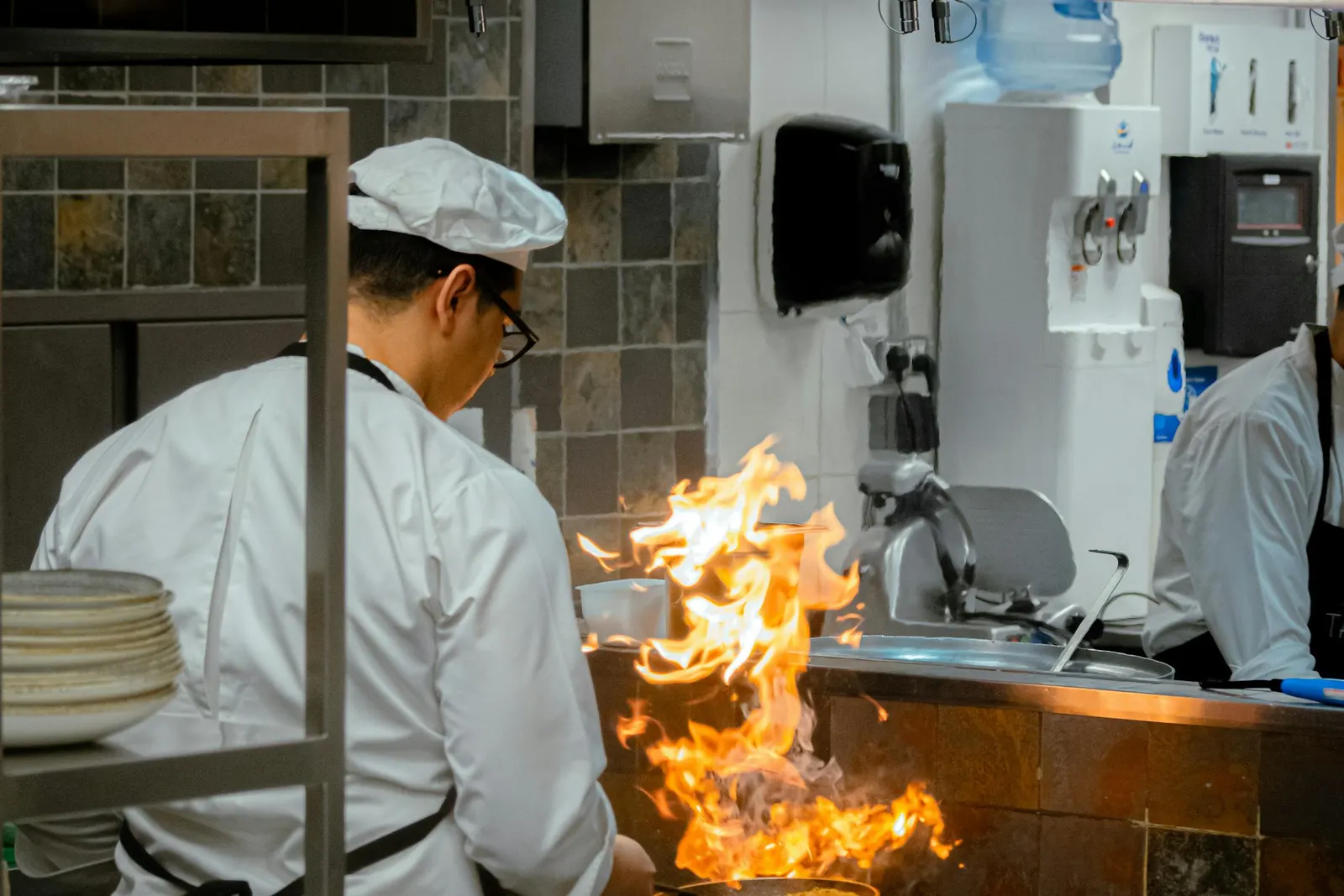
The work was a different planet. Twelve to fourteen hour shifts, six days a week. Service running 5 to 11 every night. Most weekends, all weekends. Holidays were the worst shifts of the year. Mother's Day, Valentine's Day, Christmas Eve dinner service, New Year's Eve: the days you grew up understanding as family time were the days you worked the hardest.
The pace was different. The personalities were different. The aggression of a real restaurant kitchen, the speed, the way mistakes got corrected loudly in front of everyone, the heat. It was a culture shock. Some of it I came to love. Some of it broke me down. The body started to feel it within months. Every line cook in that kind of room lives through what being in the weeds actually feels like, and the body keeps the memory of it for years.
I called this the "pit of hell" at the time, and I'd take that phrase back now because it isn't fair to the trade. The work was hard, but it was real, and it taught me things I'd never have learned in a corporate dining room. The trade-off was real on both sides. (The bars where line cooks land at 1 a.m. after service are also a real part of that life; why some of us still walk into them is the parallel piece.)

When the regret landed
Five years into restaurant work, I'd climbed. First sous chef in a serious kitchen. Then a small executive chef position at a smaller place. By every measure of the path I'd chosen, I was where I was supposed to be.
I was also burned out.
Around that time, I started running into people I'd worked with at NBC. They'd mostly stayed in corporate dining and major catering. They were doing events at the US Open in Flushing. Big jobs in Puerto Rico. Senior roles at major corporate dining and catering companies. They had partners, kids in some cases, weekends. Their careers had compounded steadily while I was breaking my back on a hot line for marginally more prestige and meaningfully less money than they made.
That was when I realized I'd traded a buildable life for a story-rich one.
What you actually give up
The friends who stayed have something the friends who left mostly don't:
- A schedule that lets you have a partner and a real relationship without scheduling conflicts
- Weekends to spend with people in the rest of the world's economy
- Holidays you spend at a table, not behind one
- A career arc that compounds toward stability, not toward burnout
- A body that lasts past forty-five
The friends who left have:
- Stories that make for great conversations
- A specific kind of professional resilience that nothing else gives you
- A working knowledge of what serious restaurants actually feel like from the inside
- A network that runs deep through the industry
- Often, a midlife pivot they're being forced to make because the body can't take it anymore
Both are real. Both are valuable. They're not equivalent.
The fork in the road, restated
If you're twenty-two or twenty-three and you're at this fork, offered a corporate dining or executive dining job and weighing it against the restaurant rockstar dream, here's what I wish I'd been told.
They are not two flavors of the same career. They're two completely different lives. The skills overlap at the level of knife work and station discipline. The lives don't overlap at all.
If the goal is the rockstar dream, go to restaurants. Take the hot line. Read Bourdain. The dream is real. The toll is also real. Plan your exit before you go in, because the body will eventually decide for you. It's also worth understanding why most of those restaurants are running on financial fumes (the lease is the recipe covers the underlying economics that shape the work).
If the goal is a buildable life — a partner you actually see, kids if you want them, a career that compounds toward stability rather than toward burnout — corporate dining is the path. It's the only chef path I know of that lets you have those things in your twenties and thirties without having to engineer them back in your forties.
The corporate path produces fewer war stories. It also produces fewer war wounds.
What I'd actually do differently
I'd have stayed at NBC. I'd have spent my twenties learning corporate dining cold instead of learning restaurants the hard way. I'd have built a career inside that world, used the connections to move into senior corporate dining or major catering, taken the stability and built a life on top of it.
Instead, I bought the Bourdain mythology. I lived years of New York City restaurant life that I wouldn't trade for any specific moment of an alternate timeline. But I also gave up the years that, looking at the friends who stayed, would have produced more of what I now actually want.
That's the trade. The romance for the structure. The story for the life.
If you're at the fork, go in clear-eyed.
What came after
Years later, I tried to go back. The German Consulate in New York City, then catering gigs, then somehow restaurants again. The pull of restaurant work is real and not entirely rational. The regret stayed real anyway. The catching-up I had to do, and what each of those chapters taught me, is the subject of pieces I'll write next.
FAQ
What is corporate dining or executive dining?
Corporate dining is in-house food service for a company's employees and executives, run as a department of the company or contracted to a specialized corporate dining firm. Executive dining specifically refers to the highest tier: private dining rooms for senior leadership, often in corporate headquarters. The food is typically restaurant-quality but the operating environment is closer to a private business than a public restaurant.
How much do corporate dining chefs make compared to restaurant chefs?
Corporate dining wages are generally competitive with or higher than equivalent restaurant positions, especially at the senior level. The major U.S. corporate dining and catering companies (Compass Group, Aramark, Sodexo, Restaurant Associates, Bon Appétit Management) pay benchmarked corporate wages with health insurance, retirement contributions, and stable employment terms most independent restaurants can't match. The pay gap widens further when you account for restaurant industry instability and lack of benefits.
What are the hours like in corporate dining vs restaurants?
Corporate dining typically runs business hours: prep starts early (4 to 7 a.m.), service runs through executive lunch and any scheduled events, and cleanup is done by late afternoon or early evening. Weekends are usually off. Holidays are usually off. Restaurant work runs 5 p.m. to 11 p.m. service plus prep, six days a week, with weekends and holidays as the busiest shifts.
Can a restaurant chef transition to corporate dining later?
Yes, and many do, usually in their thirties when restaurant work becomes physically unsustainable. Restaurant experience is often valued in corporate dining for the speed and pressure tolerance it builds. The transition is most natural at the sous chef or executive chef level. The pay cut from restaurants is often reversed: corporate dining pays better.
Is corporate dining a real career path long-term?
Yes. Senior corporate dining and catering roles can pay well into six figures, run major events (US Open, Super Bowl hospitality, corporate galas, large-scale conferences), and build into careers running food programs at Fortune 500 companies, sports venues, and major institutions. The friends I worked with at NBC who stayed in that world built bigger and more stable careers than most of the chefs I left to work with.