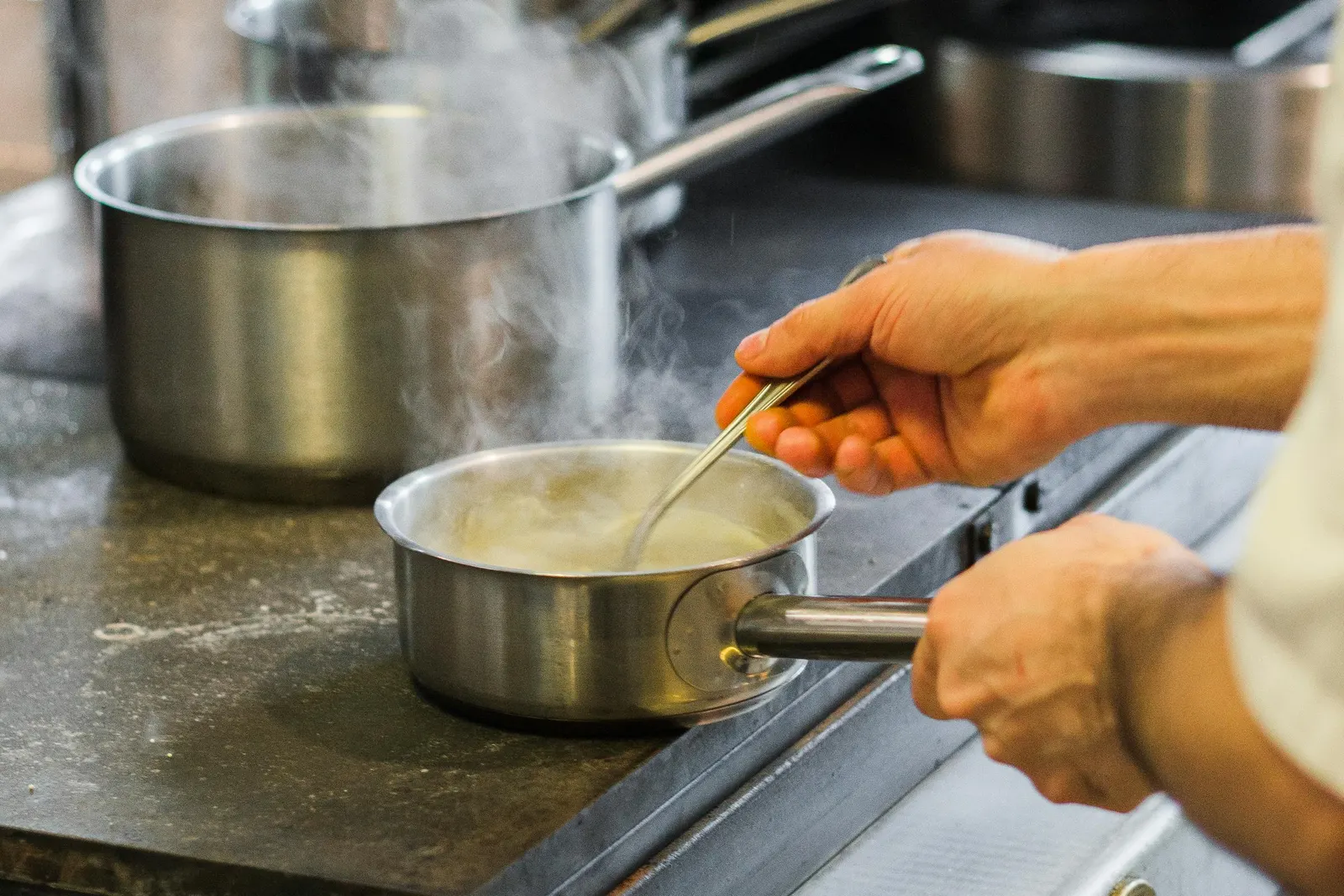
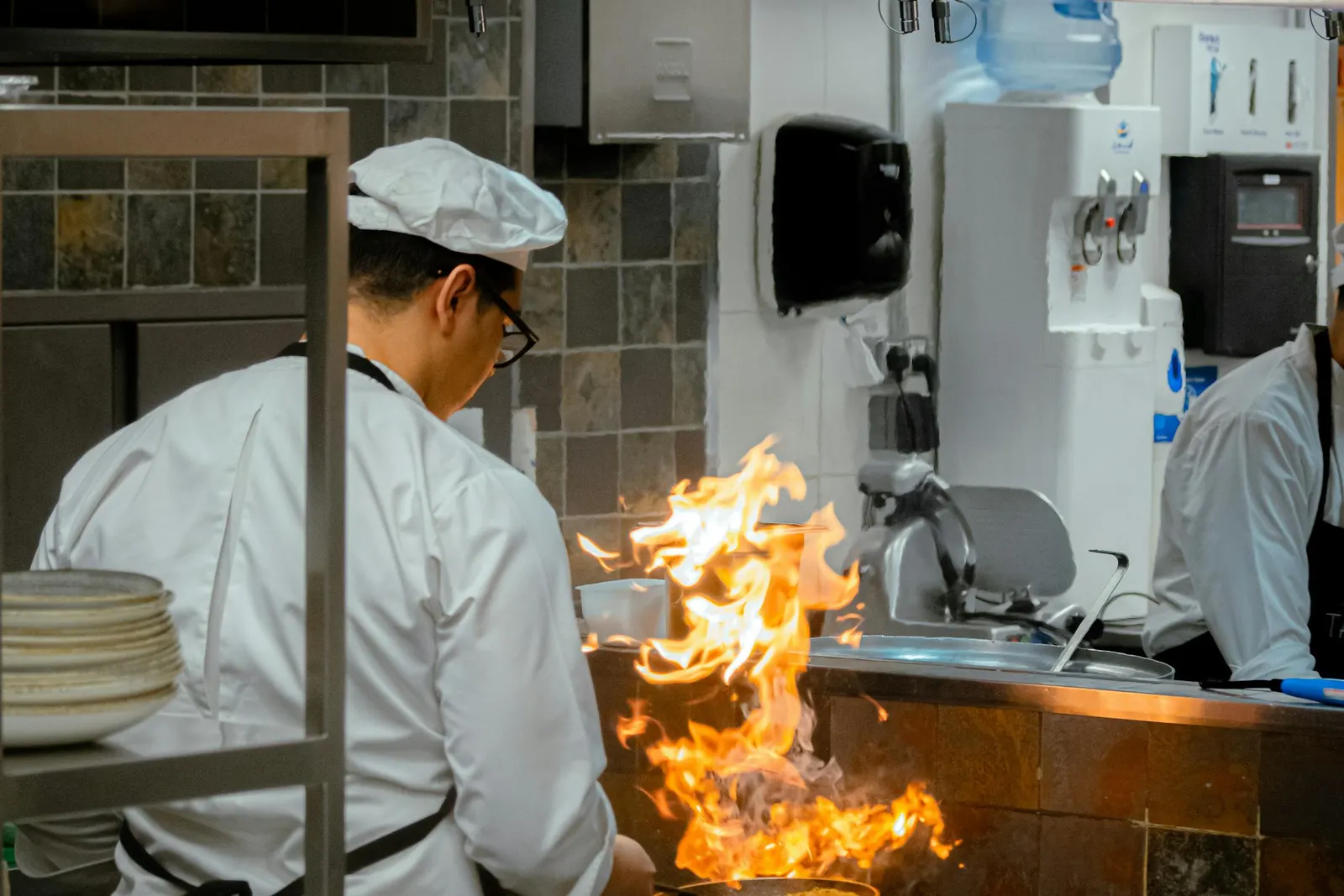
The honest answer to "is becoming a chef worth it" is: probably not, unless you understand exactly what you're trading. The career is real, the love of the work is real, and the money can eventually be real — but the cost is paid in years of nights, weekends, holidays, and physical work that most people considering the path don't fully picture. This is one former chef's honest read, written for someone in the position I was in at eighteen, about to make the decision, sold the dream, missing the asterisks. It's not a warning piece. It's the asterisks.
What the chef life is sold as
Food TV invented the modern chef: a celebrity, a brand, a person whose life is structured around invention and acclaim. The Food Network era of the late 1990s onward, then the Top Chef and Chef's Table generation, then the social-media chef wave of the 2010s, all built up a public mythology that bears almost no resemblance to the actual day-to-day work in restaurant kitchens.
The mythology runs roughly: you go to culinary school, you stage at a famous kitchen, you climb the brigade, you become the named chef on a project, you write a cookbook, you get a Netflix episode, you open your own place. The salary numbers culinary schools throw around in their marketing materials reflect this trajectory: the upper-percentile outcome treated as the typical one.
Some chefs do reach the named-chef tier. Some do open great restaurants. Some do make rockstar money. Statistically, the vast majority don't. Most working chefs are running a station at a mid-priced restaurant for a wage that, in any expensive city, isn't an easy living. There's no ownership stake. There's no path to one without ten or fifteen years of work and usually a substantial capital partner. The named-chef tier you see on TV is a fraction of a percent of the people doing the work.
The seduction is most effective on a specific kind of kid: someone with childhood food memories like cooking with a grandmother or baking for siblings, the kind of kitchen-based affection that's hard to argue with at twenty. That kid hears the marketing pitch and signs up before they've ever stepped behind a real line. I was that kid. I went to a specialized New York City high school aimed at gifted students with a tech-and-sciences track. I went to college for two years, dropped out, and went to culinary school instead. The pull was real. The pitch did its job.
The hours nobody fully describes
A kitchen runs when everyone else is off. The schedule is the single biggest cost of the trade and the one most often glossed over in the recruitment pitch.
Nights: your shift starts when most people are leaving theirs. Service runs roughly from 5 p.m. to 11 p.m., and breakdown takes another hour. Weekends: Friday and Saturday are the busiest services of the week, the highest-pressure shifts, the ones you can't take off if you want to be taken seriously. Holidays: Mother's Day, Valentine's Day, New Year's Eve, the days you grew up understanding as family time become your hardest shifts. Christmas Eve dinner service. Easter brunch. Thanksgiving in some restaurants. (Mother's Day in particular is its own beast — the chaos behind a Mother's Day brunch service is most of the reason chefs come to dread the day, and most of the reason diners should consider skipping it.)
The cost compounds. You miss the family gatherings on the days they happen. You don't make the friends your peers make in office jobs because your social hours don't align. By the time you finish service, the only people awake are other line cooks. (The line cooks you do make friends with often become some of the most important relationships of the trade; working with Mexican cooks across a decade of NYC kitchens taught me what real hospitality actually is, and most of the gatherings I attended in those years were theirs.) You stop being able to attend weddings, baby showers, regular Sunday dinners. You become available to your family on Tuesdays and Wednesdays, the days nobody else is free.
Then the physical: ten hours on your feet, often longer. Heat, repetitive motion, cuts, burns. The chefs you respect are usually nursing some long-term injury (a back, a shoulder, knees) they've been working through for years. The career is meaningfully physical in a way most professional careers aren't, and the body keeps the score.
The wages: the Bureau of Labor Statistics lists the median annual wage for chefs and head cooks at around $58,000 as of recent data, with higher figures in major coastal cities. Line cooks below the chef level make meaningfully less. The labor structure of restaurants (including the way tips, when present, get pooled and distributed) adds another layer of friction; the hidden economics of tipping pools is its own piece of the picture. The hours-to-dollars math doesn't work in your favor until you climb high enough to be the named chef on a project, and that takes most people ten to fifteen years.

The part culinary schools don't tell you
Anthony Bourdain was one of my role models going into the trade. Kitchen Confidential, published in 2000, was as close as I had to a real preview of what I was walking into. If you're considering the kitchen, read it before you sign up, not after. The Wikipedia entry for Kitchen Confidential is a fair summary if you want the shape of it before committing to the book.
What Bourdain documented, and what twenty-five years of public conversation about the industry has confirmed, is that kitchen culture has a structural relationship with substance abuse. Cocaine and alcohol in particular run through the trade in ways that most other professional environments don't tolerate. The reasons are environmental. You work nights when everyone else is off. You finish a shift at midnight or 1 a.m., amped on adrenaline, with nowhere to go but a bar. Your colleagues are mostly other line cooks who finished their shifts at the same time. The culture of "round of shots after service" is older than any of you. Money in kitchens has historically been cash-tipped, fast, and available. The work is high-pressure, physically demanding, and produces a particular kind of post-shift release that has, for generations, been mediated by substances. The bars that serve this trade are real and specific, and the reasons certain kinds of bars persist as social architecture include the kitchen-worker after-shift hour as one of their oldest functions.
This is not every kitchen. It is not every chef. The post-2010 generation of kitchens, particularly in fine dining, has gotten meaningfully cleaner. There are more sober kitchens, more wellness-aware managers, more language for the problem, more chefs publicly committed to a different culture. The visible improvement is real.
But the structural conditions haven't changed. The hours, the pressure, the late-night release, the cash, the social isolation from non-industry friends. All of it still creates the same gravity well. If you go into the trade, know that the environment will pull at you in this direction, and build the life outside the kitchen that will keep you out of the worst of it.
The years my generation built the internet
The years I spent in kitchens were the years the internet was rebuilt. Crypto. YouTube as a creator economy. The iPhone era. The rise of digital marketing as a real discipline. The SaaS wave. The early venture-capital boom that defined the 2010s. All of that happened while I was on the line.
The friends I'd grown up with on the tech track went into engineering, founded startups, joined the early teams of companies that became big. The window between roughly 2008 and 2018 was, in retrospect, one of the easiest periods in modern history to enter the technology economy. Capital was cheap. The barriers were low. The compounding for anyone who got in early was substantial. I was scrubbing a stockpot through most of it.
That's the regret part of the piece. I missed those years. I'm now in tech. I'm a founder, I do product and marketing work, I run a software business. But I got there ten years later than the peers who'd taken the obvious path. The compounding of a decade in any field is hard to make up. There's a counterfactual version of my life where I'd stayed on the tech track, and that version is, in pure financial-and-career terms, probably ahead of where I am now.
I bring this up because it's the part of the trade-off that culinary-school recruitment never mentions. You don't just sign up for the chef life. You sign up out of every other career path running in parallel. The opportunity cost of the kitchen years is the actual price of the ticket, and it's mostly invisible until you're ten years in.

What the kitchen actually taught me
Here's the part that doesn't get said enough about the trade: kitchens are one of the best management schools in the working world.
A line cook becomes a sous chef becomes a chef de cuisine becomes an executive chef. Each step is real management of real people under real time pressure with real consequences for failure. There's no business-school equivalent for running a 200-cover dinner service with eight cooks, a faulty oven, and a four-top that just walked in for an off-menu request. The training is operational, immediate, and unforgiving. When that 200-cover service goes sideways, the kitchen term for it is the ticket machine nightmare every line cook lives.
What the environment teaches:
- Composure under pressure. Service rhythms 5 to 11 nightly. Tickets stack. Equipment fails. Someone's late. You learn to keep your voice level and your hands steady through it.
- Real organization. Mise en place, or "everything in its place," is not a metaphor. You learn that systems beat will. You learn to set up your station so the worst possible night still functions.
- Reading a room. Restaurants have moods. You learn to feel a service before it goes wrong: the table that's about to complain, the energy in the kitchen that's about to snap, the regular who needs an extra minute. The skill transfers everywhere.
- Leading people who didn't ask to be led. Line cooks don't choose their sous chef. You learn to earn authority that wasn't given by title: by working harder than anyone else, by showing up before everyone, by knowing every job. That's the only kind of leadership that ever actually works. It is also the deepest lesson the kitchen brigade every cook climbs through ever teaches.
Growing up, I was a flake. Disorganized. Couldn't follow through on much. The kitchens turned me into the opposite: someone who runs spreadsheets, builds checklists, structures my life like a well-set-up station. Everything I do as a founder now (the project plans, the pipeline reviews, the morning routines) runs on the same operational logic I learned in restaurant kitchens. The trade taught me how to be the person who runs the thing.
The other thing kitchens teach is life. An office teaches you how offices work. A kitchen teaches you how people behave under stress, how money actually flows, how labor structures shape behavior, what fairness looks like in a small system, how teams break and how they rebuild. You meet people from every background, every class, every country (kitchens are some of the most demographically mixed workplaces in the United States), and you learn to read them quickly. You learn that the person doing the hardest job is often the most invisible. You learn that the named chef is often not the one keeping the operation running. The financial pressure on the whole enterprise (the rent, the margins, the lease that was signed before any of you were hired) is also visible from the line in a way it isn't from an office cubicle, and the reality that the lease is often the recipe becomes obvious within your first year on a station.
That kind of education isn't on offer in most professional environments. It's the part of the trade I'd defend to anyone considering it.

Why I'm not having a midlife crisis
There's a thing that happens to a lot of men in their late thirties and forties. You see it in friends, in coworkers, in news stories: the sudden realization that the safe career path didn't include the years they thought they wanted to spend doing something else. The mid-career reckoning. The expensive car. The new hobby. The marriage strain. The question of whether they did what they wanted to.
I don't have it. Not in any acute form. The reason, I'm fairly sure, is that I lived my twenties with the dial all the way up.
A chef in New York City in your twenties is doing what you wanted to do. The work is hard but the life is full. You're surrounded by other young people working at the same intensity. You eat at every restaurant in the city because the chefs at every restaurant know you. You drink with line cooks at 1 a.m. in bars that exist for that purpose. You travel to Italy, Spain, Mexico to stage in a kitchen for a month. You're tired all the time but you're awake to the city in a way most office jobs don't allow. The whole New York City food scene of that era was something I was inside of, not adjacent to.
I lived three years on a rural farm afterward, in a quieter chapter that came later. That should have felt like a step down. Most people in their thirties would tell you a rural farm is what you do when you've given up on the city. I never felt that. The reason is simple: I'd already done the city, hard. The thing some of my peers seem to be chasing now in their forties (the late-career exuberance, the "let me really live now") I did when I was twenty-three and twenty-four and twenty-eight. I don't have a deficit to make up.
That's the trade-off the chef life buys you that doesn't appear in the marketing pitch. The years are hard, but they're full. You spend your twenties inside one of the only working environments left where the day is genuinely different from the office, the people are genuinely different from the office, the rhythm is genuinely different from the office. By the time the trade releases you, or you release it, you've already lived. The settling-down part feels like a reward, not a defeat.
It's the part I'd most defend if I had to defend the choice. The cost is the years. The payoff is that the years were lived.

What I'd actually tell someone considering it
If a kid asked me today what I'd tell my eighteen-year-old self about the trade, here's what I'd say.
Go in if you've already loved it. If you've worked a kitchen shift somewhere (even as a dishwasher, even for a summer) and you came out the other side wanting more, that's the only real test. The romance of the trade evaporates in week one of an actual line. The people who stay are the people for whom the actual work is the thing.
Don't go to culinary school first. Get a job in a real kitchen. Work it for six months. If you still want to be there, then maybe consider school. Even then, consider whether the money would be better spent on rent while you stage in serious kitchens for free or cheap. The school certificate doesn't open doors that the work doesn't already open.
Plan your exit before you go in. This is the one I wish someone had told me. The trade takes its toll on bodies and time. The chefs who do best long-term are the ones who climb to executive chef and then transition: into ownership, into food media, into product, into teaching, into something that uses what the kitchen built without continuing to extract from the body. Plan that pivot from the start. Mid-thirties to mid-forties is the natural transition window.
Watch for the gravity wells. Bourdain. The drinking. The isolation from non-industry friends. The way the trade can become your whole identity. Build the life outside it from day one.
Take the lessons. The discipline, the organization, the leadership, the ability to read a room. All of those transfer to every other career. If you eventually leave, you'll leave with one of the most useful skill sets in the working world.
The honest summary: the trade is harder than it's sold and richer than it's described. If you go in clear-eyed, you can come out with a life most office careers don't produce: full, varied, lived. If you go in believing the marketing, you'll spend years angry that the brochure lied.
I went in believing the marketing. I came out anyway with something I wouldn't trade. That's the answer.
FAQ
Do you need culinary school to become a chef?
No. Plenty of working chefs (including some of the most respected in New York and worldwide) came up entirely through line work. School is a faster entry point and a network, not a requirement. The cheaper path is to get hired as a prep cook somewhere, work your way up, and stage at the kitchens you admire on your days off. Most kitchens care more about how you handle a station than where your certificate came from.
How long does it take to become a chef?
The title "chef" (meaning you actually run a kitchen) typically takes eight to fifteen years from the start of the trade. Sous chef level is usually four to eight years in. The path is longer than most professions; the compounding pays off later, not earlier. If you're not in love with the work itself, the wait will feel unbearable.
What do chefs actually make?
The Bureau of Labor Statistics lists the median annual wage for chefs and head cooks at around $58,000 nationally as of recent data, with significantly higher figures in major coastal cities. Line cooks below the chef level make meaningfully less. The headline numbers in culinary-school marketing usually reflect the upper percentile, not the median. The math improves substantially only at the executive-chef level and above.
Is the substance-abuse problem still real in kitchens?
The structural conditions that produce it haven't changed: nights, pressure, late-night release, available cash. The visible culture has improved meaningfully since the Bourdain era; many serious kitchens are notably cleaner than they were twenty years ago, and the conversation about it is more open. The risk is still real for anyone going in. Build the social infrastructure outside the kitchen before you need it.
Is it too late to become a chef in your 30s?
Not impossible, but the math gets harder. The career is physical and the years compound. Most career-switchers in their thirties end up in pastry (less brutal hours, more skill-based) or in food businesses adjacent to the line: catering, food media, product, teaching. (Corporate dining and executive dining is the parallel-chef-life path that's especially worth knowing about, both for career-switchers and for anyone choosing between paths the first time around.) Going from a 30-something white-collar job to running a hot line in a serious kitchen is rare and uncomfortable. If the goal is "be near food professionally," there are better paths than the brigade at that age.