To cook pasta properly, boil it in a large pot of water salted until it tastes like the sea, using roughly a gallon (four liters) of water and about a tablespoon of salt for every 100 grams of pasta. Pull the pasta about two minutes before the package time, while it still has a firm core, and finish it in the pan with its sauce and a splash of starchy pasta water, tossing until the sauce turns glossy and clings to every strand. Portion around 100 grams of dried pasta per person. Skip the oil in the water, and skip the rinse. That is the whole method.
Everything else in this guide is detail on those few moves: how much pasta to cook, how much water and salt, when to pull it, and how to bring it together in the pan. Get those right and the box in your cupboard stops being weeknight filler and starts being one of the best fast dinners there is.
I did not grow up eating pasta. I grew up in a Colombian household, which meant I grew up on rice. Rice with everything, rice as the quiet foundation of almost every plate. Pasta was around, but it was not the center of the table. That flipped when I was an adult and, oddly, when I started cooking professionally. Most of the kitchens I came up in were Italian, and I spent real time on the pasta station: rolling and cutting fresh sheets, folding ravioli by hand, cooking dried shapes to order through a Friday rush. Somewhere in there pasta went from a thing I ate to the thing I reach for most. What still gets me is how simple it is. Flour and water, or semolina and water, and yet the range of what you can do with it runs from a two-ingredient aglio e olio to a filled agnolotto that takes a full afternoon. Simple does not mean easy to do well, and the difference between fine pasta and great pasta is almost entirely in the handful of steps below.
How Much Pasta Per Person?
The standard restaurant portion is 100 grams (about 3.5 ounces) of dried pasta per person for a main course. That is the number to anchor on. Cooked, it roughly doubles in weight as it absorbs water, so 100 grams dried lands around 200 to 250 grams on the plate, which is a satisfying but not heavy serving.
The portion moves depending on what the pasta is doing in the meal. As an Italian primo (a first course before a meat or fish course), 60 to 80 grams is right, because it is not meant to fill you. As the whole dinner, especially with a lean sauce, 110 to 125 grams per person is more honest about how much people actually eat. Fresh pasta is lighter and wetter than dried, so you want a little more of it by weight for the same effect.
If you have no scale, long dried pasta has a reliable trick: measure the bundle by diameter. A bundle of dried spaghetti about the width of a US quarter, roughly 24 millimeters, is close to one 100-gram main-course portion. Smaller bundle for a smaller portion, wider for a bigger one.
| Portion | Dried pasta | Fresh pasta | Dried spaghetti bundle |
|---|---|---|---|
| Child's portion | 50–60 g | 65–75 g | a small pinch |
| First course / primo | 60–80 g (2–2.8 oz) | 80–100 g | about a penny across (~19 mm) |
| Main course | 100 g (3.5 oz) | 120–125 g | about a US quarter across (~24 mm) |
| Big appetite | 115–125 g | 150 g | a bit wider than a quarter (~26 mm) |
Round up slightly if the crowd is hungry or the sauce is light, and round down if the sauce is rich and meaty. Leftover cooked pasta also reheats better than most people expect, which I will get to at the end, so cooking a little extra is rarely a mistake.
How Much Water, and How Much Salt?
Two questions that decide the whole texture of the dish, and both get answered wrong constantly.
Water. The old rule is a gallon (about four liters) of water per 100 grams of pasta. You can use a bit less and be fine, but do not crowd the pot. Pasta needs room to move so it cooks evenly and does not clump, and a big volume of water recovers its boil faster after you add the pasta, which matters for even cooking. The one thing you gain from using less water is a more concentrated, starchier cooking liquid, which is genuinely useful for finishing the sauce. So there is a small trade-off, but for most cooks, err toward more water and a hard rolling boil.
Salt. Salt the water until it tastes distinctly of salt, like a well-seasoned soup or, in the usual shorthand, like the sea. In practice that is roughly one tablespoon of table salt, or a bit more of coarse kosher salt, per gallon of water. This is the only chance you get to season the pasta itself from the inside; sauce sits on the outside, but salted water seasons the starch as it hydrates. Under-salted water gives you pasta that tastes flat no matter how good the sauce is.
Add the salt once the water is boiling, not before. Salt raises the boiling point a hair and can pit the bottom of some pots if it sits undissolved in cold water, and there is no benefit to adding it early. There is also no need to wait for the salt to fully dissolve before adding the pasta; drop the pasta in right after the salt and stir.
Cooking Pasta to the Right Doneness
This is the step people miss, and it is the difference between pasta and mush. You want to pull the pasta while it still has a firm, barely-underdone core, because it will keep cooking after it leaves the water. That target is al dente, and it is not a texture preference so much as a specific, visible moment in how the starch cooks. I wrote a whole piece on what happens inside the strand at that exact moment, but the short version for cooking is this: start tasting a strand about two minutes before the package time says it is done.
You are looking for a strand that is tender on the outside but still has a thin, firm center when you bite through it. Cut a piece in half and you will see a faint pale line at the core; when that line is barely there, drain. If you plan to finish the pasta in a sauce, which you should, pull it even earlier, because it will finish cooking in the pan.
The package time is calibrated for pasta you drain and eat straight, with no finishing step. It runs long for the way good cooks actually work. Trust your teeth and your eyes over the clock. And before you drain, do the one thing almost everyone forgets: save a mug of the cooking water. That cloudy, starchy, salty water is the ingredient that makes the next step work.
Finishing the Pasta in the Sauce
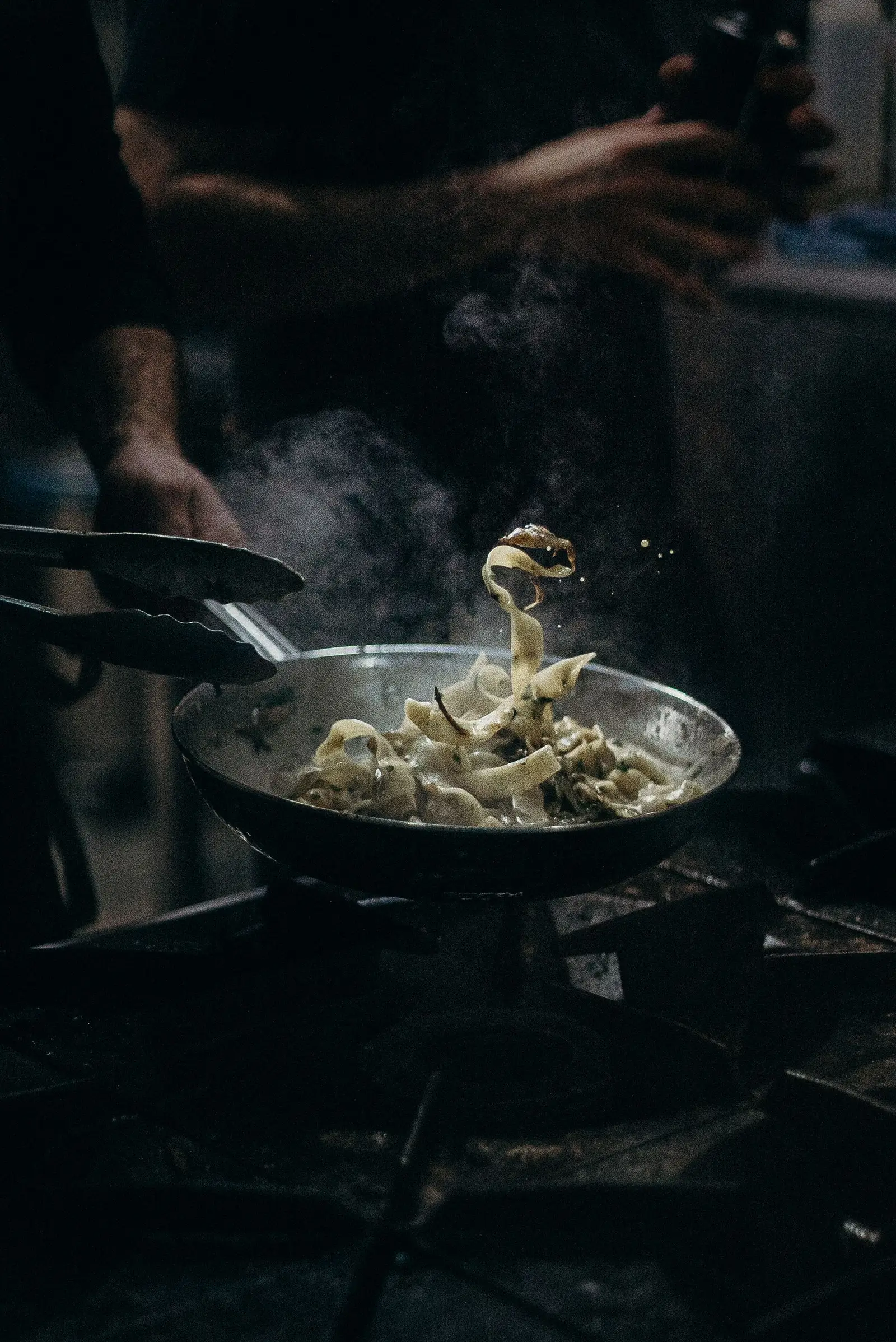
Here is the single move that separates home pasta from restaurant pasta, and it is not a secret so much as a habit almost nobody has at home. Do not drain the pasta, dump it in a bowl, and ladle sauce on top. Instead, have your sauce warm and loose in a wide pan, add the just-underdone pasta directly to it along with a splash of the reserved pasta water, and cook the two together for the last minute or two, tossing constantly.
What happens in that pan is real physics, not fussiness. The starch the pasta shed into the cooking water, plus the starch on the strands themselves, emulsifies with the fat in the sauce, the same way starch and rendered juices thicken and bind a proper pan sauce. The sauce goes from a thin liquid that pools at the bottom of the bowl to a glossy coating that clings to every strand. Add pasta water a little at a time if it looks tight; boil it down for a few seconds if it looks loose. You are cooking the sauce onto the pasta, not just next to it.
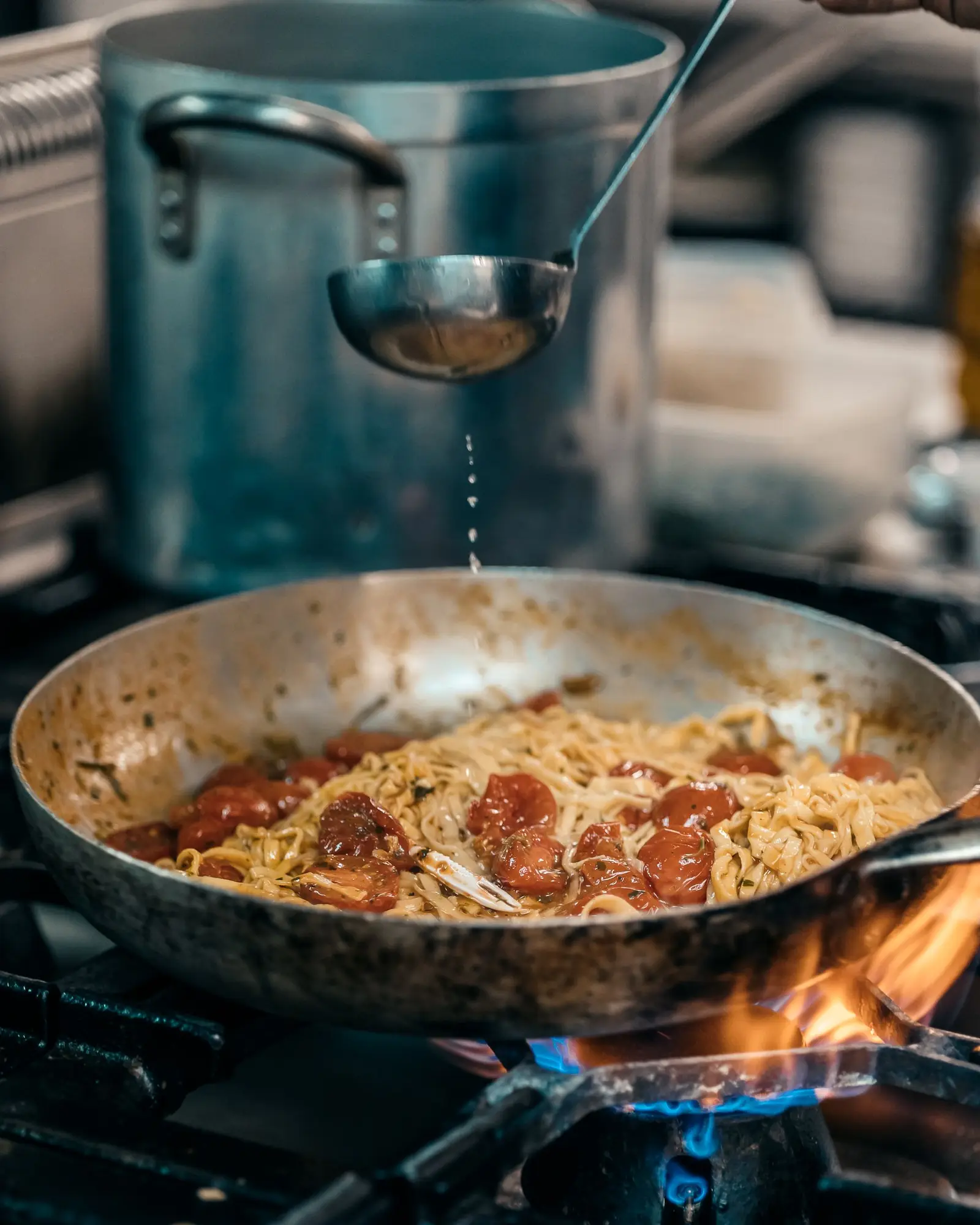
On the line, this was the whole game. The sauce pans were already going before the pasta ever hit the water, so that when a shape came up to the drain, its partner was hot and waiting. You lift the pasta straight from the water into the pan, dripping and carrying its own starch, toss hard over high heat, cut it with a little pasta water, and plate it the second it comes together. The pasta is never sitting. That is why a restaurant bowl arrives glossy and integrated and a home bowl so often arrives with a naked pile of noodles under a puddle. Same noodle, better handling. The heavier the sauce, the more this matters: a dense, slow-cooked pasta alla Genovese needs that final toss in the pan to keep the amber onion ragù clinging instead of sliding off.
Finish off the heat with whatever the dish wants: a knob of butter tossed in for shine, a handful of grated cheese, a few torn herbs, a final grind of pepper. Cheese goes in off the flame so it melts into the sauce instead of seizing into strings, and which of the hard grating cheeses you use decides how forgiving that moment is.
Matching the Shape to the Sauce
Shape is not decoration. Every pasta shape is engineered to hold a certain kind of sauce, and matching the two is a quiet part of cooking pasta well. Long, thin strands like spaghetti and linguine want smooth, oily, or lightly clinging sauces that coat their length: garlic and oil, the Roman classic cacio e pepe, a simple tomato. Ribbons like tagliatelle and pappardelle have more surface and can carry richer, meatier sauces like a ragù. Tubes and shapes with ridges or hollows, like rigatoni and shells, are built to trap chunky sauces and bits of meat or vegetable inside and against them.
The general rule is simple: the heavier and chunkier the sauce, the more structure the shape should have to catch it; the lighter and silkier the sauce, the longer and smoother the shape can be. If you want to go deeper on which shape does what and why, from bucatini to trofie, I put together a full guide to the pasta shapes and what each one is for. For now, the practical takeaway is to stop treating shapes as interchangeable. Reaching for the right one is free and it makes the dish better.
Should You Rinse Pasta?
No, do not rinse pasta you are about to sauce. Rinsing washes away the surface starch that helps the sauce grip, and it cools the pasta down right when you want it hot for finishing. That starchy coating is an asset, not something to clean off. Drain the pasta, keep it moving toward the pan, and let the starch do its job.
There is exactly one exception. If you are making a cold pasta salad, rinsing under cool water stops the cooking and washes off enough starch to keep the pasta from gluing itself into a block as it chills. For anything served hot with a sauce, no rinse, ever.
Myths Worth Dropping
A few habits get passed around that do nothing or actively hurt the dish.
- Oil in the boiling water. It does not stop pasta from sticking; the oil floats on top and never touches the pasta while it cooks. What it does do is coat the drained pasta in a slick film that keeps sauce from clinging. Stirring in the first minute prevents sticking; oil just sabotages the finish.
- Breaking long pasta to fit the pot. Use a bigger pot or let the ends soften and slide the strands under as they go. Breaking spaghetti is a small crime against every sauce designed to be twirled.
- Adding pasta to water that is not fully boiling. Pasta dropped into merely warm water goes gummy on the outside before the inside cooks. Wait for a hard, rolling boil.
- Throwing pasta at the wall to test it. Overcooked, sticky pasta sticks to a wall. So does properly cooked pasta if it is wet enough. It tells you nothing. Bite a strand instead.
How to Fix Overcooked Pasta
If the pasta is genuinely mushy, no amount of technique fully rescues the texture, but you can make it good again instead of throwing it out.
The best move is to give it a crisp exterior it no longer has on the inside. Drain it well, then pan-fry it in a hot skillet with a little oil or butter until parts of it brown and firm up, almost like a pasta version of crispy rice. Overcooked pasta also disappears nicely into baked dishes, where a soft texture matters less: fold it into a frittata, bind it with egg and cheese and bake it into a pasta cake, or layer it into a gratin. And slightly, mildly overshot pasta, not mush but a touch past al dente, still finishes fine in a sauce; just skip the extra pan time and toss it briefly to coat. The lesson is to pull it earlier next time, but a soft batch is not a lost batch.
How to Reheat Pasta Without Ruining It
Plain leftover pasta and sauced leftover pasta reheat differently, and both do best with a little added moisture.
For pasta already tossed in sauce, reheat it in a pan over medium heat with a splash of water or stock, tossing until it loosens and warms through. The water re-loosens the sauce and rehydrates the noodles so they come back to something close to fresh. A microwave works too: add a spoonful of water, cover, and heat in short bursts, stirring between them. For plain, un-sauced pasta, the fastest fix is to drop it into boiling water for ten to twenty seconds, just long enough to heat and re-loosen it, then drain and sauce it as if it were fresh. Either way, the enemy of reheated pasta is dryness, so always reintroduce a little liquid.
FAQ
How much pasta do I need per person?
About 100 grams (3.5 ounces) of dried pasta per person for a main course. Drop to 60 to 80 grams if the pasta is a first course before a meat or fish dish, and go up to around 120 grams for big appetites or a light sauce. Fresh pasta runs a little heavier by weight for the same serving. If you have no scale, a bundle of dried spaghetti about the diameter of a US quarter is close to one main-course portion.
How much salt should I add to pasta water?
Enough that the water tastes clearly salty, like a well-seasoned soup or the sea. That is roughly one tablespoon of table salt, or a bit more coarse kosher salt, per gallon of water. Salt the water once it is boiling. This is the only step that seasons the pasta itself, so do not skimp; sauce alone cannot fix bland, under-salted pasta.
What is the pasta-to-water ratio?
About one gallon (four liters) of water per 100 grams of pasta is the classic ratio. You can use less if your pot is smaller, but do not crowd the pasta, and keep the water at a hard boil. Using slightly less water gives you a starchier cooking liquid, which is actually helpful for finishing the sauce in the pan.
Should I rinse pasta after cooking?
No, not if you are serving it hot with a sauce. Rinsing strips the surface starch that helps sauce cling and cools the pasta down when you want it hot. The only exception is cold pasta salad, where a quick cool rinse stops the cooking and keeps the pasta from clumping as it chills.
How do I stop pasta from sticking together?
Use plenty of water at a full boil, and stir the pasta for the first 30 to 60 seconds after it goes in, when the surface starch is at its stickiest. That is all it takes. Do not add oil to the water; it does not prevent sticking and it keeps sauce from adhering later. If cooked pasta will sit before saucing, toss it with a little of the sauce or a spoon of its cooking water to keep it loose.
Why does my pasta taste better at restaurants?
Because restaurants finish the pasta in the sauce. They pull it underdone, then cook it for a final minute or two in a pan with the sauce and a splash of starchy pasta water, so the sauce emulsifies and clings instead of sliding off. At home, most people drain fully-cooked pasta and pour sauce on top, which never integrates the two. Adopt the pan-finish step and your pasta closes most of that gap immediately.
Can I cook pasta ahead of time?
Yes. Cook it a minute short of al dente, drain, toss with a little oil to keep it from clumping, and refrigerate. To serve, either dunk it in boiling water for 10 to 20 seconds or finish it straight in a hot sauce with a splash of pasta water. This is exactly how restaurants hold pasta through a busy service, and it works fine at home for a dinner party.