Pecorino and Parmesan are both hard grating cheeses, and in most dishes you can trade one for the other without anybody noticing. The catch is salt. Pecorino Romano carries roughly 1,800 mg of sodium per 100 g against Parmigiano-Reggiano's 650, so the swap is never one for one: put pecorino where parmesan was and you have to pull salt out somewhere else. And in the Roman pastas, pecorino isn't a preference. It's the dish.
Sheep versus cow is the easy part. Salt is the real one.
"Pecorino" just means sheep's cheese, from pecora. There are dozens of them across Italy, sharp and mild and young and ancient. The one people mean in this comparison is Pecorino Romano, and it has rules. Its production disciplinare requires whole fresh sheep's milk and lamb-paste rennet, permits production only in Sardinia, Lazio, and the province of Grosseto, and sets the aging clock at five months minimum for a table cheese and eight for a cheese destined to be grated.
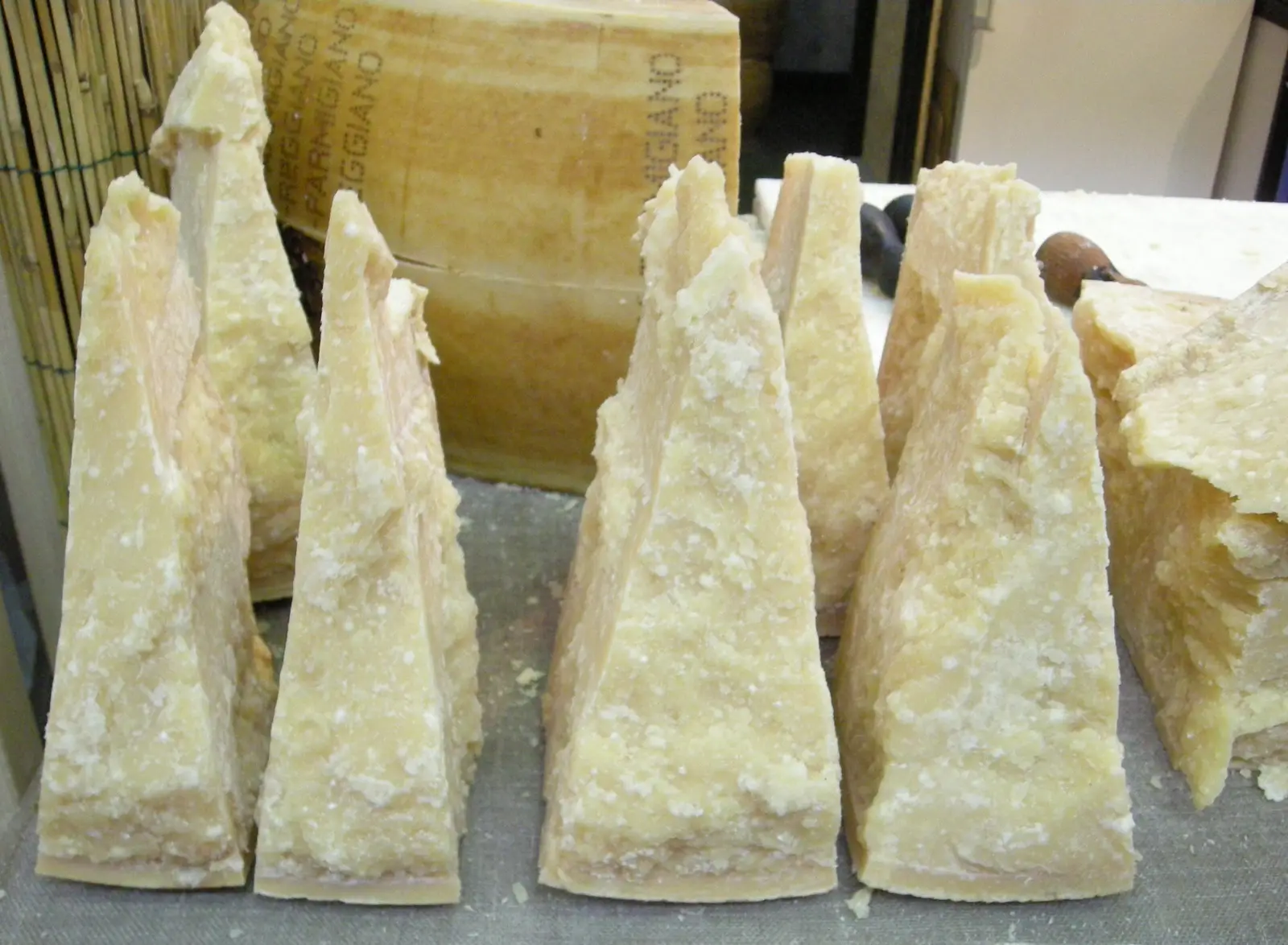
Parmigiano-Reggiano runs on a different clock entirely. Raw cow's milk, three ingredients total, five provinces around Parma and Reggio Emilia, and a twelve-month minimum that most wheels blow past. The stuff you buy is usually two years old, sometimes three. That extra year is where the crunchy white tyrosine crystals come from, and most of the nuttiness.
| Pecorino Romano | Parmigiano-Reggiano | |
|---|---|---|
| Milk | Whole sheep's milk | Raw, partly skimmed cow's milk |
| Where | Sardinia, Lazio, Grosseto | Parma, Reggio Emilia, Modena, parts of Bologna and Mantua |
| Minimum age | 5 months (table), 8 months (grating) | 12 months, commonly sold at 24–36 |
| Sodium per 100 g | ~1,800 mg | ~650 mg |
| Fat per 100 g | ~33 g | ~30 g |
| Protein per 100 g | ~26 g | ~32 g |
| Flavor | Sharp, tangy, faintly barnyard, aggressively salty | Nutty, sweet, savory, crystalline |
| Behavior in a hot sauce | Breaks and clumps easily | Forgiving |
Read the sodium row twice, because it governs everything else. Those figures come from CREA, the Italian government's food composition database, and from the Parmigiano-Reggiano Consortium's own nutritional data. Pecorino isn't slightly saltier. It carries close to three times the sodium, which works out to something like 4.5 g of salt per 100 g against 1.6. A heavy hand of pecorino is a seasoning decision, not a garnish.
Where the swap is fine
Most of the time, honestly. Anywhere the cheese is functioning as a seasoning rather than as the structure of a sauce, the two are close enough that the substitution is invisible to everyone but you:
- Finishing soups, brothy beans, and minestre off the heat
- Meatballs, meatloaf, and stuffings
- Breadcrumb toppings for gratins and baked pasta
- Roasted or grilled vegetables, asparagus especially
- Frittatas and savory tarts
- Pesto, which traditionally uses both anyway
- Anything where the cheese goes on top at the table
Both wedges earn their keep in a properly stocked kitchen, and if you only have one, use the one you have. Just taste before you reach for the salt.
Where it isn't
Four pastas, all Roman, all built on pecorino: cacio e pepe, gricia, amatriciana, carbonara. These aren't dishes that happen to use pecorino. The sharpness of sheep's milk against pork fat and black pepper is the entire architecture, and Parmigiano's sweetness collapses it into something pleasant and wrong. Rome does not treat this as a matter of taste, and eating your way through the city makes the reason obvious within about two meals.
The reverse trips people up more often, because it's less discussed. Pecorino where Parmigiano belongs is just as bad in the other direction. A long-simmered ragù, a risotto mounted with butter and cheese at the end, a delicate brodo, a plate of shaved cheese with pears and honey: pecorino bulldozes all of it. It's a loud cheese. Loud is right for four Roman pastas and wrong for a risotto you spent thirty minutes stirring.
Why pecorino breaks a sauce that Parmigiano holds
The clumping is real and it has a physical explanation. Pecorino carries more fat and less protein than Parmigiano, so when it hits heat the casein network tightens and squeezes fat out instead of staying suspended. You get a broken, grainy sauce with a rubbery knot of cheese in the middle of it.
A group of Italian physicists actually measured this. Their 2025 paper in Physics of Fluids, Phase behavior of Cacio e Pepe sauce, mapped what happens to a pecorino-and-water sauce as it heats, and named the failure state the "Mozzarella Phase": below about 1% starch relative to the cheese mass, the whole system throws clumps. Their stable window was 2% to 3% starch. Which is a laboratory way of saying what Roman grandmothers have said forever, that the pasta water is not optional and there needs to be enough starch in it.
The rule, in four parts
Grate it much finer than you think. Fine shreds dissolve; coarse ones seize into knots. This matters more for pecorino than for anything else in the fridge.
Take the pan off the heat. Every hard cheese goes into a sauce off direct heat, and pecorino is the least forgiving of the lot. Residual heat in the pan is plenty.
Go half and half when you're unsure. Half pecorino, half Parmigiano is the most useful cheat in this whole comparison. You keep most of the sharpness, you cut the salt load meaningfully, and the Parmigiano stabilizes the emulsion that the pecorino wants to break. Plenty of Roman kitchens do exactly this and don't advertise it.
Then pull salt out somewhere else. Salt the pasta water lighter than usual, skip the finishing salt entirely, and taste before you correct. If you swap in pecorino and season the dish the way you always do, you have made a salty dish, and no amount of technique fixes that afterward. It's worth knowing how the water and the starch actually work before you start adjusting either.
What a kitchen actually keeps
I cooked in Italian restaurants in New York for years, classical rooms and the more American-Italian kind, and both cheeses were always in the walk-in. Not as alternatives to each other. As different tools.
Pecorino is my favorite of the two, and I'd argue it's the more useful one. Parmesan gets all the attention in the States, to the point where a lot of home cooks have never bought a wedge of anything else, and I think that's backwards. Pecorino does more. It finishes a soup with a sharpness that wakes the whole bowl up. It emulsifies into a sauce if you respect it. It's good enough to stand on its own on a board with nothing but bread, which is how it's eaten in Lazio and Sardinia and why the disciplinare bothers to define a younger table version at all.
And the rinds never got thrown out. Both of them went into a container, and when there were enough, into the stockpot. A parmesan or pecorino rind simmered into a broth gives back a savory depth you can't get any other way, and it costs nothing, because you already paid for it. That habit alone changes the math on buying whole wedges.
Buying either one without getting fooled
Look for the stamp, because in the United States the word on the label protects you from nothing. "Parmesan" is a generic term here, so a domestic wedge labeled parmesan may be a perfectly decent cheese or may be a pale imitation, and the name won't tell you which. Real Parmigiano-Reggiano has its name pin-dotted around the entire rind. Real Pecorino Romano carries a stamped lozenge with a stylized sheep's head.
Buy the wedge, not the tub. Pre-grated cheese is cut with anti-caking agents that keep it from clumping in the package and also keep it from melting properly in your pan, which is a strange bargain to accept for the one job you bought it to do. Grate it yourself as you need it, ideally with a rasp grater, which produces exactly the fine shreds that dissolve instead of seizing.
Then keep the rind. That is the last piece of value in the wedge, and most people throw it away.
FAQ
Can I substitute Parmesan for Pecorino Romano?
Yes, in most dishes. Parmigiano is milder and much less salty, so the result will be sweeter and rounder than intended, and you will probably need to add a little salt to compensate. The exceptions are the Roman pastas, where the swap changes the dish into something else.
Is Pecorino Romano saltier than Parmesan?
Considerably. Pecorino Romano runs around 1,800 mg of sodium per 100 g, while Parmigiano-Reggiano sits near 650 mg. That's close to three times as much, which is why a one-for-one swap in either direction throws the seasoning of a dish off.
Is pecorino or parmesan healthier?
Neither one is a health food, and at the quantities you actually eat the gap is small. Per 100 g, Parmigiano-Reggiano carries more protein, roughly 32 g against pecorino's 26, and under half the sodium. Pecorino has slightly more fat. If sodium is the thing you are watching, Parmigiano is the easier cheese to use freely. The Consortium also notes that Parmigiano-Reggiano is naturally lactose-free at that age.
Which cheese is correct for carbonara?
Pecorino Romano. Carbonara belongs to the same Roman family as cacio e pepe, gricia, and amatriciana, all of which are built on sheep's-milk sharpness cutting through cured pork fat. Many cooks use a mix of pecorino and Parmigiano to soften the salt and stabilize the sauce, and that's a defensible compromise, but pure Parmigiano makes a different dish.
Why does my pecorino clump instead of melting?
Two reasons, usually. The pan was too hot, or there wasn't enough starch in the water. Pecorino's high fat and lower protein content make its curd network contract and squeeze out fat under heat. Grate it fine, pull the pan off the burner, and use genuinely starchy pasta water rather than fresh water from the tap.
Can you use Pecorino Romano and Parmigiano-Reggiano together?
You should, often. A half-and-half blend keeps most of pecorino's sharpness while cutting the salt and making the sauce far more stable. It's a common working solution in restaurant kitchens and a good default if you're nervous about either cheese taking over.