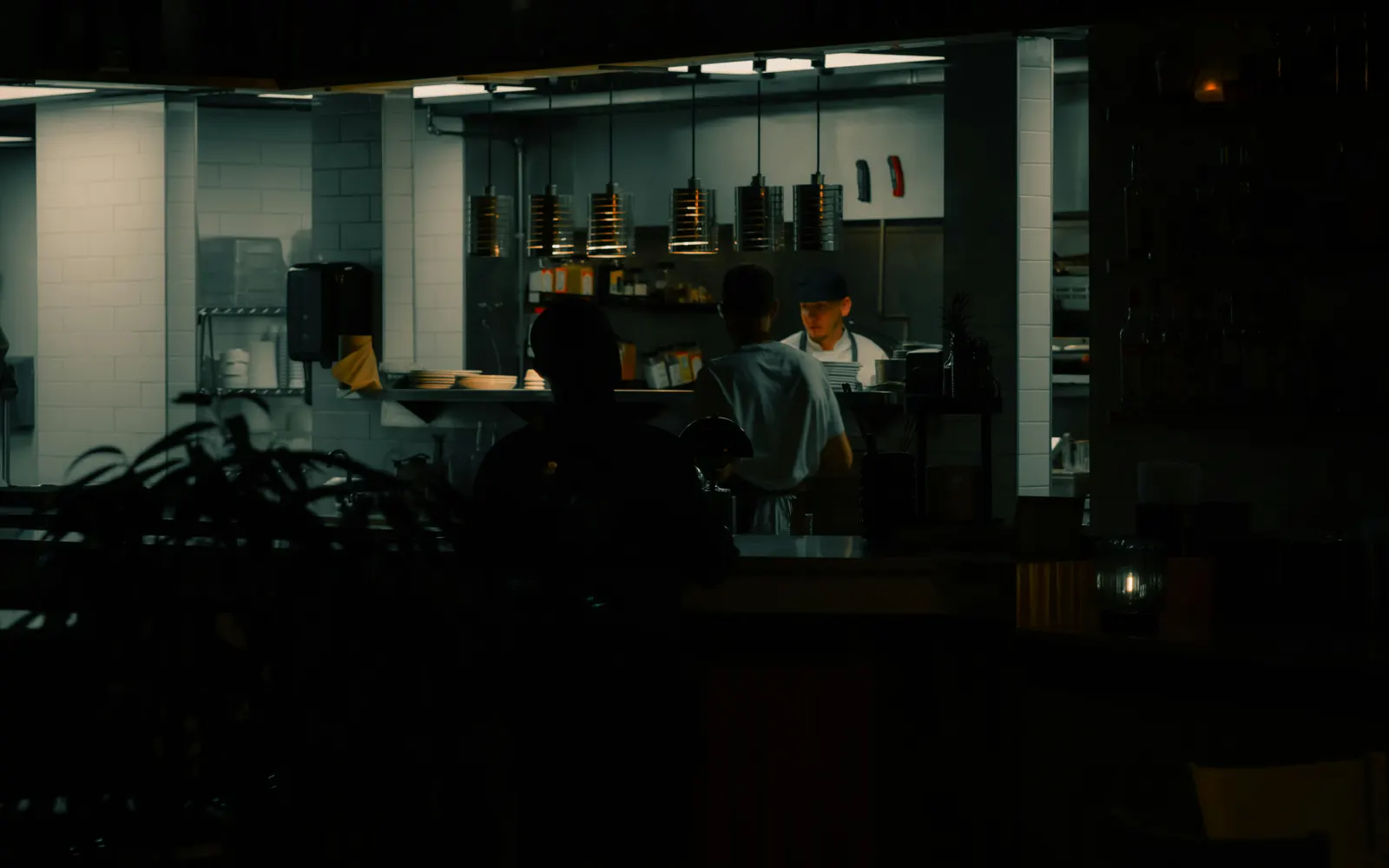
Walking into a restaurant within thirty minutes of closing is rude. Walking in within an hour is iffy. A former chef's personal rule: nothing within two hours of close. The reason is not that cooks will sabotage your food, which is mostly a movie trope and not how working kitchens actually behave. The reason is energy. By the last hour of service, the line has been standing for eight hours, the stations are cleaned and reset, and the love that goes into a properly fresh meal is gone. Your food will be technically correct. The care behind it will not be.
What "late" actually means
For the purposes of this piece, late is anything inside the last hour of a restaurant's posted closing time. Inside thirty minutes is the rude version. An hour out is the gray zone. My personal rule, and the one I would offer to any thoughtful diner, is two hours before close at the latest.
That sounds extreme on the surface. It is not. The reason is something diners almost never see: the actual rhythm of a service shift, and what it does to the people working it.
By the time a restaurant is two hours from close, the line cooks have been on their feet for somewhere between seven and ten hours. The dish station has been catching plates and silverware since lunch. The bartender has been making drinks for the better part of the evening. Most of these people went on shift in the afternoon, ran a hot dinner service from six to nine, and are now in the back half of the night just trying to make it to the door.
You can still get fed. The kitchen will fire your order. You will get a plate. The food will be technically correct because that is what professional kitchens do, even when exhausted. What you will not get is the quiet attention that a fresh kitchen brings to a dish at seven thirty. That attention is real, and you can taste it. What those cooks eat once the shift finally ends, and what they eat the following afternoon, is a different subject entirely.
The closing-time math nobody outside the industry knows
Here is the math that breaks people's brains when they hear it for the first time.
A restaurant closes at eleven PM. You walk in at ten thirty. The host seats you. The server takes your order at ten forty-five. The kitchen fires it. Your food comes out around eleven oh five. You eat, you talk, you enjoy yourselves. You order coffee. You linger.
You leave at midnight.
From your side, that is perfectly reasonable. You showed up before closing time. You did nothing wrong. Right?
Here is what happened on the other side of the swinging door. The kitchen stayed open past close because you were still ordering. The cooks who would have been wrapping their station and clocking out at eleven could not, because there was a ticket up. Once your food went out, they started breaking down again. They could not finish until you finished. You finished at midnight. Now they have forty-five minutes of cleaning ahead of them. The dishwasher has another hour of plates to run. The bartender is still doing inventory.
The cooks leave at one in the morning. They were there at three PM for prep. The same kitchen-exhaustion math plays out in the opposite direction at brunch, and the chef-side view of why sunday brunch is so brutal on a kitchen is its own piece on this site.
That is the math. A ten thirty arrival, even one that ends at a perfectly reasonable midnight, means somebody was at that restaurant for ten hours that day, and the last two of them were because of you. The flip side of this thinking, the one most diners never get told, is covered in the best time to arrive at a restaurant: show up early and you get the fresh kitchen on its best legs.
What actually happens in the kitchen when a late table walks in
Here is the part that diners cannot see and that I want to make visible.
Imagine you have just run a busy Friday night service. Three hundred and fifty covers. The kitchen banged it out. You are exhausted in the particular way that only people who have been on their feet for nine hours and in front of a flat top for six can be exhausted.
The last ticket cleared at ten. You have thirty minutes left on the clock. You wipe down your station. You scrape the grill and re-season it. You wash and bleach the cutting boards. You break down the mise en place that did not get used. You put everything in its place for the morning prep cook. The line looks like a museum exhibit. Clean. Done. You are mentally already at the bar across the street.
Then a four top walks in at ten thirty.
The grill that you just scraped has to be greased back up and brought back to temperature. The flat top has to be fired again. The sauté pans you washed have to come out of the rack and onto the burners. The cutting board you bleached has to be re-stained with shallot and herb. The dishwasher who was about to start his final rack has to wait. The line cook who had one foot out the mental door has to put his apron back on.
The food will get made. The plates will go out. The kitchen will do its job. But every cook on that line is now going to be there an extra hour past when they thought they were going home, and they are going to spend that extra hour redoing work they already did.
This is not personal. It is not directed at you. It is a perfectly natural human response to having your nightly routine broken in the most predictable way possible. The cook is not angry at you. The cook is angry at the situation. The whole rhythm of late service has its own kind of misery, which is part of what being "in the weeds" actually means on a working line.
The gratitude flip from line cook to executive chef
I have done both sides of this. I worked the line for years and I felt the late-table frustration as much as any cook does. Then I became an executive chef, and the perspective shifted.
An executive chef sees the spreadsheet. An executive chef knows what a four top at ten thirty actually means in dollars. American restaurants run on margins so thin that the math is genuinely brutal. A typical full-service restaurant clears somewhere in the low single digits as a percentage of revenue. Every cover counts. The lights have to be paid for. The rent has to be paid for. Payroll has to be paid for. Every person who walks in and orders is part of how that math works out for the month.
That four top at ten thirty might be two hundred dollars of revenue, plus another fifty in alcohol. On a slow Wednesday in February, that two hundred and fifty dollars is the difference between a month that hits target and one that does not. The same logic is why restaurants charge a few dollars for bread that costs them almost nothing to bake: every margin matters, every cover matters, every line item is part of the survival math.
Once you have signed the lease yourself and looked at a P and L statement, the frustration changes shape. It does not go away. The cleaning still has to happen. The cooks are still tired. But you become grateful for every guest, because every guest is part of the reason the restaurant is open at all.
This is why the host does not turn the four top away. The host knows. The chef knows. Ownership knows. The line cook in the back, whose body is past the point of fresh, does not yet have that perspective. That is the split. Both responses are real and both responses are true.
Why you won't get the best meal
This is the practical reason I am writing this and the reason I would not, as a former chef who knows what is happening on the other side, walk into a restaurant in the last hour.
The food I get will be technically correct. The pasta will be cooked. The protein will be at the temperature I asked for. The plate will be properly composed. I will not catch the kitchen out doing anything wrong. The discipline of a professional kitchen survives even at the end of the night.
What I will not get is the quality that comes from a cook who is fresh. When you order a perfectly executed pan sauce at seven thirty, you are eating something a cook made with all of their attention. The shallot was sweated for the right length of time. The wine reduced until the sharp edges were gone. The cold butter went in with the kind of focus that produces a silky, glossy sauce. The dish takes twelve minutes either way. The difference is what was done with those twelve minutes.
At ten forty-five, that same dish will get made by a person whose body has been working for nine hours. The shallot might cook a beat longer than ideal. The reduction might go a touch further than it should. The butter goes in, and it works, because the cook has done this two thousand times. The plate goes out, and it is fine, and it is finished, and it is not the dish you would have eaten at seven thirty.
The same thing happens at the bar. The bartender at seven is making your cocktail with care. By eleven, after three hundred drinks, they are still competent but they are not curious. The drink is fine. It is not memorable.
You can be a normal person who has dinner at eight and gets the best version of every part of the meal. Or you can be the table at ten thirty getting the technically correct version. The difference shows up on the plate.
My personal rule as a diner now
I do not walk into a restaurant within two hours of close. Period.
If the restaurant closes at eleven, I am in by nine. If they close at midnight, I am in by ten. That is my rule. I have broken it twice in my entire life as a diner since leaving the trade, and both times I felt it in the meal.
Two hours feels generous because it is. It is the buffer that lets me know the kitchen is still in rhythm, the line is still firing on all cylinders, and the staff is not yet in the mental tunnel of closing down. It is also early enough that the table I am sitting at is not the last table to be cleared. Somebody else will be at the late table. Somebody else will be the four top that walks in at ten thirty. I do not need to be that person.
It is not about being a hero. It is just about knowing the math and choosing accordingly.
If you have to come in late, here is how to do it right
Sometimes you have to. You got out of work late. The first show ran long. You missed your earlier reservation. Fine. Here is the etiquette that makes you a good late guest instead of a bad one.
- Order everything at once. Appetizers, mains, sides. No staggering. Every additional course you order one ticket at a time keeps the kitchen open longer than it has to be.
- Skip dessert. Or order it from a place that is not the kitchen, like a coffee and a chocolate from the bar. The pastry station is shut. They will reopen it for you, but they will resent it.
- Do not modify the dishes. This is not the time to ask for the sauce on the side, the protein swapped, the substitution. Order what is on the menu, the way the menu describes it.
- Tip very well. Twenty-five percent at minimum. More is better. You are extending these people's working day. Their compensation should reflect that.
- Do not linger. Pay quickly. Decline the second round of coffee. The meal ends when the meal ends. The cooks cannot leave until you do.
- Be especially kind to the server. They are the bridge between you and the kitchen. Their warmth in the moment will get carried back to the line.
Do all of this and you are still the late table. But you are the right kind of late table. The kitchen will not love you, but they will not hate you either.
It is not rudeness. It is ignorance.
This is the part I want to land on, because most diners are not malicious people deliberately ruining cooks' nights. They genuinely do not know the math.
Nobody outside the restaurant industry has any reason to know that a kitchen does not stop at the posted closing time. Nobody knows the bartender is going to be there another two hours after the last drink. Nobody knows the line cook started prep at three PM. The information is not visible from a diner's seat. It is on the other side of a door labeled "kitchen" that customers are not supposed to push through.
I am writing this article so that the information is visible. Once you know, you can choose. You can decide whether the convenience of a ten thirty dinner is worth the cost it imposes on people you will never meet. Most readers who learn the math will quietly start arriving earlier, and every cook in America thanks them in advance.
The bigger framework here is that going out to eat is mostly an occasion-fit problem. A late dinner is one specific kind of occasion, and the right restaurant for it is rarely the one most people pick by default.
Late-night service has its own particular kind of hard, especially in the kind of room that runs past two in the morning. I have written about that life from the inside in working at an industry bar, where the rhythm is different but the same exhaustion math applies.
FAQ
Is it rude to walk into a restaurant 30 minutes before closing?
Yes. Inside thirty minutes is the rude version of late dining. The kitchen has cleaned the line, the staff has been on their feet for eight to ten hours, and your arrival means everyone is staying past their posted end of shift. The food will get made, but you will get the tired version of the dish. A former chef's personal rule is to never walk in within two hours of close.
Do cooks really mess with your food if you come in late?
No. The trope is mostly a movie thing. Professional kitchens have too much discipline and too much pride to do that, even when frustrated. What you actually get is the technically correct version of the dish without the care a fresh cook brings to it. The food is fine. The energy is not.
What time should you arrive at a restaurant?
In general, the sweet spot is the start of dinner service to about an hour into it. If a restaurant opens at five thirty for dinner, arriving between six and eight gets you the best version of the meal: a fresh kitchen, a full menu, attentive service. The general rule of thumb for the best time to arrive at a restaurant is to beat the rush; the late equivalent of that rule is to never arrive in the last two hours of service.
Why do restaurants stay open if they really want you to leave?
Because every cover matters financially. Restaurants run on thin margins, and the host who turns away a late four top is turning away two to three hundred dollars of revenue plus alcohol. Ownership knows this. The chef knows this. The line cook in the back, who is just tired, has not yet seen the spreadsheet. Both perspectives are real. The host's job is to take the customer; the kitchen's job is to honor them. The strain between those two roles is what produces the late-table tension.
How long after closing time do staff actually leave?
Usually one to two hours past close, sometimes longer. The kitchen has to fully clean down: scrub the line, break down stations, prep the mise for the next day. The dishwasher has to finish every plate. The bartender does inventory. The front of house resets the dining room. If you walk in thirty minutes before close, you are roughly doubling the back half of someone's shift. That is the cost most diners cannot see.


