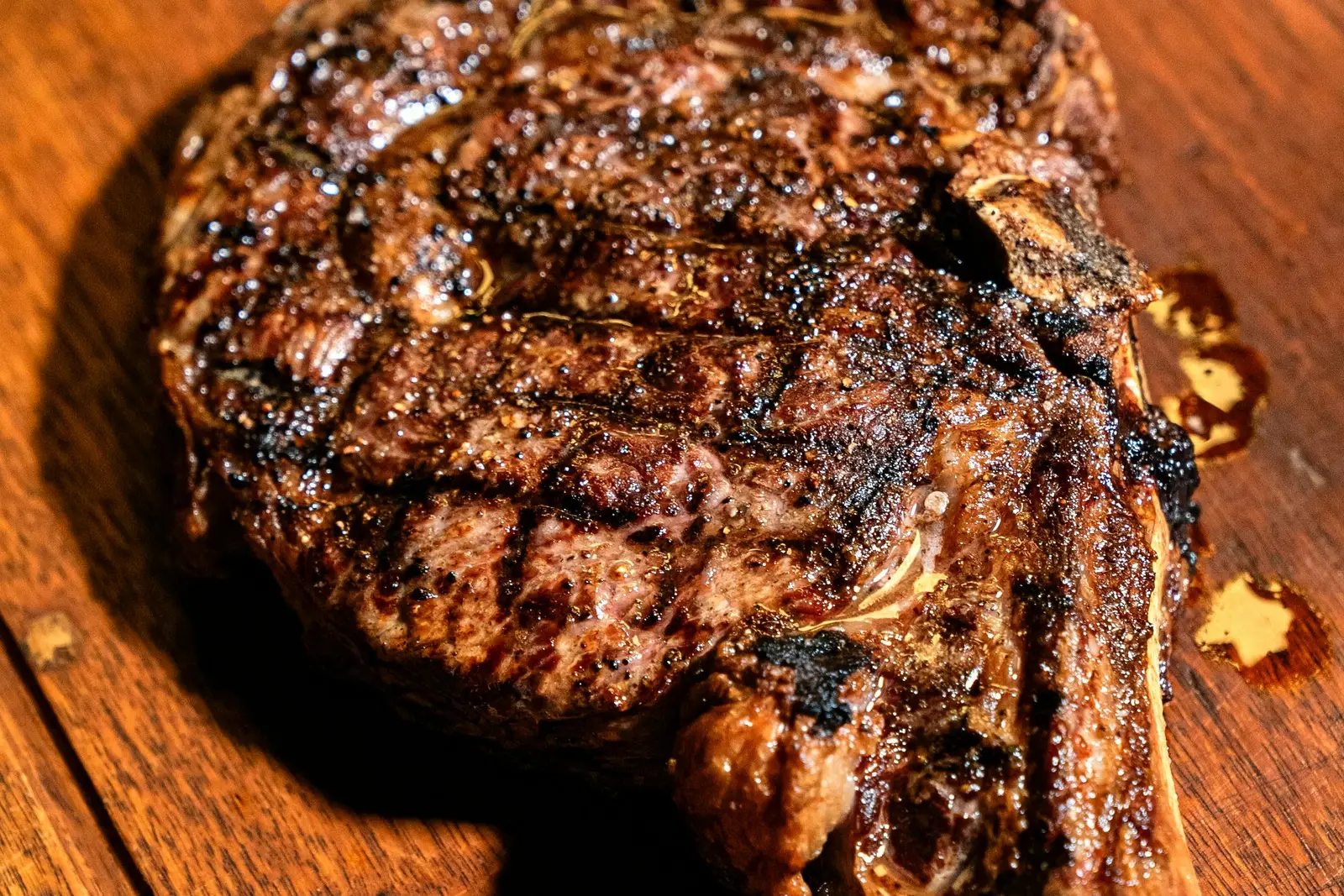
Ribeye vs New York Strip is the steakhouse question with two right answers. Ribeye comes from the rib section, carries heavy intramuscular marbling, and includes the cap (the spinalis), which is the most flavorful piece of beef on the animal. Strip comes from the short loin just behind it, has a tighter grain, less fat, and a cleaner beef-per-bite character. Ribeye is the more forgiving cut, the more luxurious mouthful, the easier cook. Strip is the leaner steakhouse classic, the better pan-sauce cut, and often the smarter buy for someone who doesn't want a steak that eats like butter. The right pick depends on the dinner.
What a ribeye is
The ribeye comes from the rib primal, specifically ribs six through twelve on the animal. It is built from three muscles fused together: the eye (longissimus dorsi), which is the large central round; the cap (spinalis dorsi), which wraps around the outside; and a small inner section (complexus) that varies in size from steak to steak.
The cap is the part chefs hide for themselves. It is the most marbled, most flavorful piece of beef on the entire cow. On a well-cut ribeye, you can see it as the dark, heavily streaked crescent on the outer edge, separated from the eye by a seam of fat. When a butcher carves the cap out and rolls it into its own little steak, that is the ribeye cap roll, and it is one of the best things you can put on a grill.
Heavy marbling is the ribeye's signature. The intramuscular fat renders during cooking, bastes the meat from inside, and produces a rich, almost buttery finish. The fat also makes the cut forgiving on the grill. You can be a minute late pulling a ribeye and it still eats beautifully. That generosity is one of the reasons it is the most popular cut in American grocery stores, and why it's my pick for the best steak to grill.
The cut comes boneless or bone-in. Bone-in adds visual drama (cowboy steak with a short frenched bone, tomahawk with a long one), but the bone does not add meaningful flavor. The cook is slower and slightly less even around the bone. Save the bone-in money for a thicker boneless cut or a dry-aging upgrade.
What a New York strip is
The strip comes from the short loin, just behind the rib section. It is cut from the same long muscle that runs through the ribeye (the longissimus dorsi), but only that one muscle — there is no cap, no complexus, no fat seam wrapping the outside. The strip is the eye of the ribeye, alone.
That structure gives the strip a different eating experience. The grain is tighter. The marbling is finer and less abundant. The flavor is cleaner and beefier in a way that does not rely on fat doing the work. Where the ribeye coats the mouth, the strip cuts through it.
A few things to know about the cut at the case:
- The strip is a leaner muscle than the ribeye. Less marbling, less rendering fat, less forgiveness on heat. A well-cooked strip is excellent. An overcooked strip dries out fast.
- A strip can be sold bone-in or boneless. Bone-in is sometimes called a Kansas City strip. Same caveats as bone-in ribeye: the bone is more about presentation than flavor.
- Porterhouse and T-bone are strip plus filet. Both cuts include a strip on one side of the bone and a tenderloin on the other; porterhouse has a larger filet portion. They are essentially a strip with a bonus.
The strip is the steakhouse default for a reason. It plates as a clean rectangle, slices into uniform medallions, and reads as a more refined cut than a ribeye. Most American steakhouses sell more strip than any other cut.
Ribeye vs New York strip side by side
The numbers tell most of the story.
| Ribeye | New York strip | |
|---|---|---|
| Where it sits | Rib primal (ribs 6–12) | Short loin, behind the rib |
| Muscle structure | Eye + cap + complexus | Eye only |
| Marbling | Heavy, with a fat seam | Finer, more distributed |
| Flavor | Rich, buttery, fat-forward | Cleaner, beefier, leaner |
| Texture | Loose, varies across the cut | Tighter, more uniform |
| Forgiveness on heat | High | Lower |
| Price | Usually higher | Usually 15–30% less |
| Best use | Special-occasion grilling | Steakhouse-style pan-seared |
The cleanest way to think about it: a strip is what you get when you remove the most flavorful part of a ribeye (the cap) and sell the remaining muscle on its own. That is not an insult to the strip. The eye of a ribeye is excellent meat, and selling it without the cap is what gives the strip its own identity (tighter, leaner, more uniform). The full version of this thinking is in the broader map of grilling and steakhouse cuts, which sets these two against bavette, hanger, filet, and the rest. If your priority is tenderness rather than flavor, the comparison shifts to filet mignon against the ribeye, which is a different question entirely.
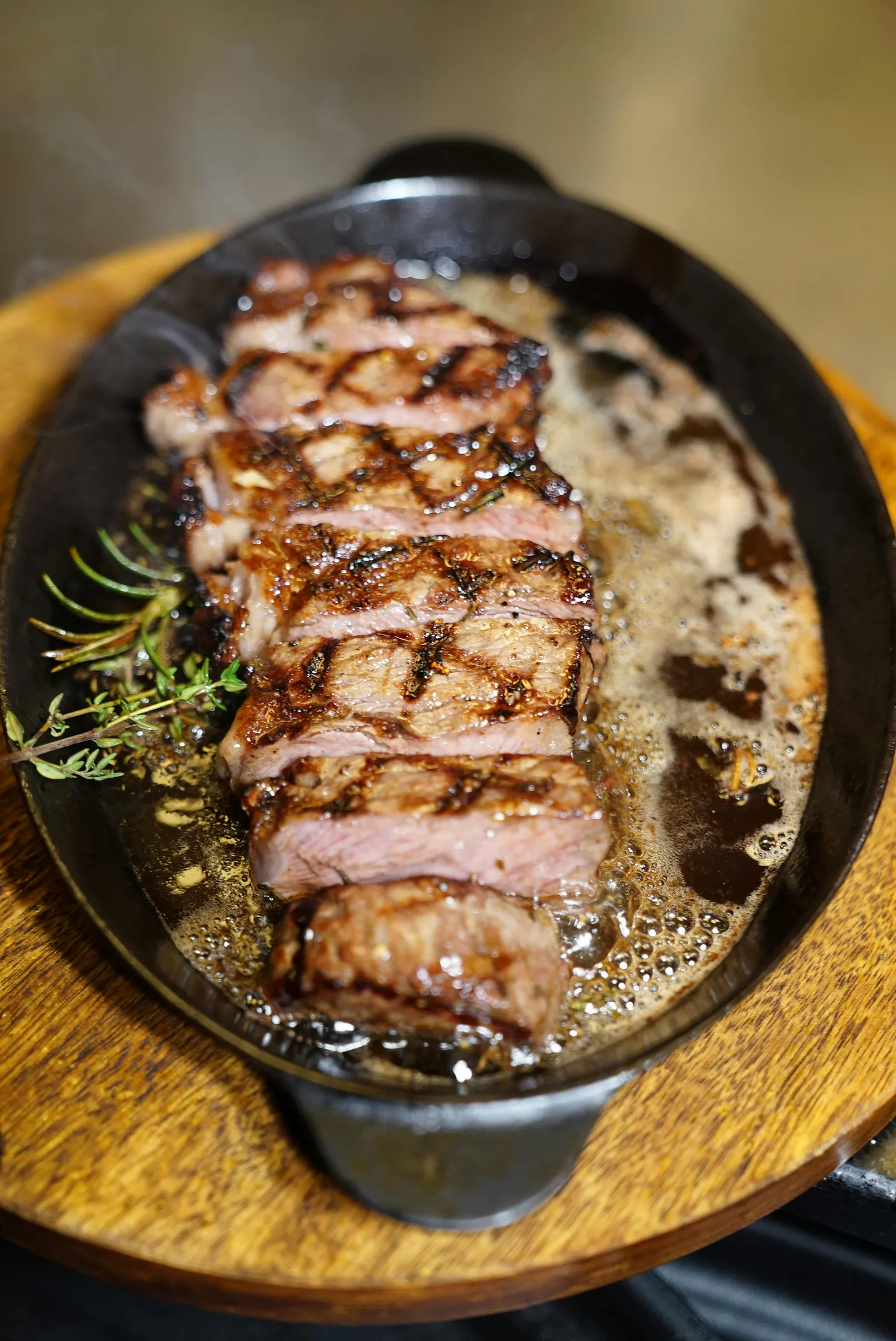
How to cook a ribeye
Ribeye is the most forgiving steak in any American grocery case. That doesn't mean cook it carelessly; it means small mistakes recover.
- Salt it like a steak that wants time. Coarse kosher salt, generous, the night before if it's a thick cut. The fat needs time to set up under the dry brine. The science is in the right way to salt a steak, and a thick ribeye is exactly the cut that pays for the wait.
- Sear it hot. Screaming cast iron or a hot grill, or sear it and finish it in the oven. The fat cap renders, bastes the meat, and produces the deep brown crust ribeye is famous for.
- Pull at 125 to 130 internal. Off the heat, rested five to ten minutes. Carries up to 130 to 135. Past medium, the marbling has fully rendered into the pan and the texture starts to firm up.
- Slice or serve whole. Thick enough to portion (over 1.25 inches), it can be sliced across the grain and fanned out. At standard 1-inch thickness, it eats well as a whole steak per plate.
A reverse sear is the move for any ribeye over 1.5 inches. Low oven to internal 110, then a hard sear in cast iron to finish. The interior cooks evenly and the crust still develops cleanly because the surface is dry by the time it hits the pan.
How to cook a New York strip
The strip is a tighter window. Same general technique, sharper attention to timing.
- Salt the same way, but the timing matters more. Strip has less internal fat to insulate the muscle, so a too-early pull or a too-late pull is more visible in the slice. Dry brine the night before for thick ones; salt right before for thin.
- Hottest pan you can manage. Carbon steel or cast iron, smoking. The strip needs a hard crust because it doesn't have ribeye's fat to carry the cooked flavor on its own.
- Pull at 125 to 130, no later. Same window as ribeye, less margin. Use a thermometer if the cut is thicker than 1 inch.
- Rest, then slice across the tight grain. The strip's grain is more uniform and runs in one direction. Slice perpendicular to it, about half an inch thick, on a slight bias.
Strip is the better cut for a pan sauce. The lower fat content means a cleaner fond on the bottom of the pan, easier to deglaze, easier to mount into a sauce that doesn't read as greasy. Where a ribeye sauce can verge on too rich, a strip sauce tends to balance the plate.
When each cut wins
This is where the article earns its keep. Both cuts are good. The right one depends on the dinner.
- Ribeye wins for a special-occasion grilling steak. The marbling delivers the richest mouthfeel of any common cut, the cap is a small religion of its own, and the forgiveness on heat means an outdoor grill with people watching is exactly the right setting.
- Ribeye wins for someone who loves fat. If you want the steak to taste like the steakhouse you remember (the one whose ribeye made you remember it), ribeye is the cut. Strip will read as a leaner, more restrained experience and feel like the wrong pick.
- Ribeye wins for a less experienced cook. The fat buffers timing mistakes. Strip punishes them faster.
- Strip wins for a clean steakhouse experience. Strip plates as a perfect rectangle, slices into uniform medallions, and produces the kind of restrained, deeply beefy slice that defines the American steakhouse style. Most steakhouses sell more strip than ribeye because of this.
- Strip wins for a pan sauce dinner. Less rendered fat in the pan means a cleaner fond, an easier deglaze, a sauce that balances the plate instead of doubling the richness. A red wine pan sauce on a strip is one of the best home dinners you can make.
- Strip wins for someone fat-averse. The strip is the cut for a guest who finds ribeye too rich. The flavor is still deeply beefy; the mouthfeel is just lighter.
- Strip often wins on price. A great strip at fifteen to twenty dollars a pound from a good butcher eats better than a mediocre ribeye at the same price. This is one of the corners where the USDA grade matters as much as the cut — a well-marbled Choice strip is the steakhouse experience without the Prime premium.
For the thin-cut version of this same decision (cheap, fast, taco-leaning), the answer is in hanger steak vs skirt steak. For the broader question of which cut you're actually buying when you walk up to the case, a good butcher will tell you which one in his case today is the better piece, ribeye or strip.
FAQ
Which is more tender, ribeye or New York strip?
Ribeye is slightly more tender than New York strip, mostly because of its higher fat content. Both cuts come from the same long muscle group along the cow's back, but the ribeye includes the cap (spinalis), which is significantly more tender and more marbled than the eye muscle alone. The strip is the eye on its own, with a tighter grain and less internal fat. Both eat tender at medium-rare; the difference is closer to "buttery" vs "clean."
Which is more expensive, ribeye or New York strip?
Ribeye is usually 15 to 30 percent more expensive per pound than New York strip at the same grade. The ribeye carries more marbling and includes the cap, which is the most valuable piece of meat on the animal, so the cut commands a premium. Prime-grade pricing widens the gap further. A well-marbled Choice strip from a good butcher often eats better than a mediocre Prime ribeye, which is part of why strip is the better value most of the time.
Is the bone-in ribeye (cowboy or tomahawk) worth it?
Not really. The bone does not add meaningful flavor to the meat during a normal cook (the bone is dense and the flavor transfer is minimal). What the bone does add is presentation, cooking time, and uneven heat distribution near the bone. A cowboy steak with a frenched short bone is fine; a tomahawk with a long bone is mostly theater. If you want to spend the bone-in premium on something that actually changes the eating experience, spend it on a dry-aged boneless ribeye instead.
Is a dry-aged ribeye or strip worth the upgrade?
Yes, for special occasions, and the strip benefits from dry-aging more than the ribeye does. Dry-aging concentrates beef flavor and adds a distinctive nutty, funky character that builds over 30 to 60 days. The strip's already-cleaner beef profile carries that character beautifully and ends up tasting like the platonic ideal of a steakhouse steak. The ribeye also benefits, but its marbling is already doing most of the flavor work, so the gain is smaller. For dry-aged, the strip is the better value.
What is the ribeye cap (spinalis) and should you order it separately?
The ribeye cap, or spinalis dorsi, is the outer crescent of muscle that wraps around the eye of a ribeye. It is the most marbled, most tender, and most flavorful piece of beef on the entire cow, and a small but growing number of butchers cut it out and roll it into its own small steak called a ribeye cap roll. If your butcher offers it, yes, order it. A four-ounce cap roll eats like the best bite of the best ribeye you've ever had, repeated.
If you have read this far, you deserve the honest version. Ribeye is the cut I have reached for my entire cooking life: as a diner, as a home cook, and through my years working professional kitchens. The cap is something I think about more than I should. But the case for New York strip is real, and it is not a runner-up case. Strip wins on price, on pan sauces, on clean steakhouse presentation, and for any cook who doesn't want their dinner to read like butter. Pick by what you're cooking, not by which name has the bigger reputation. Both are excellent. Most of the time, the dish is the tiebreaker.