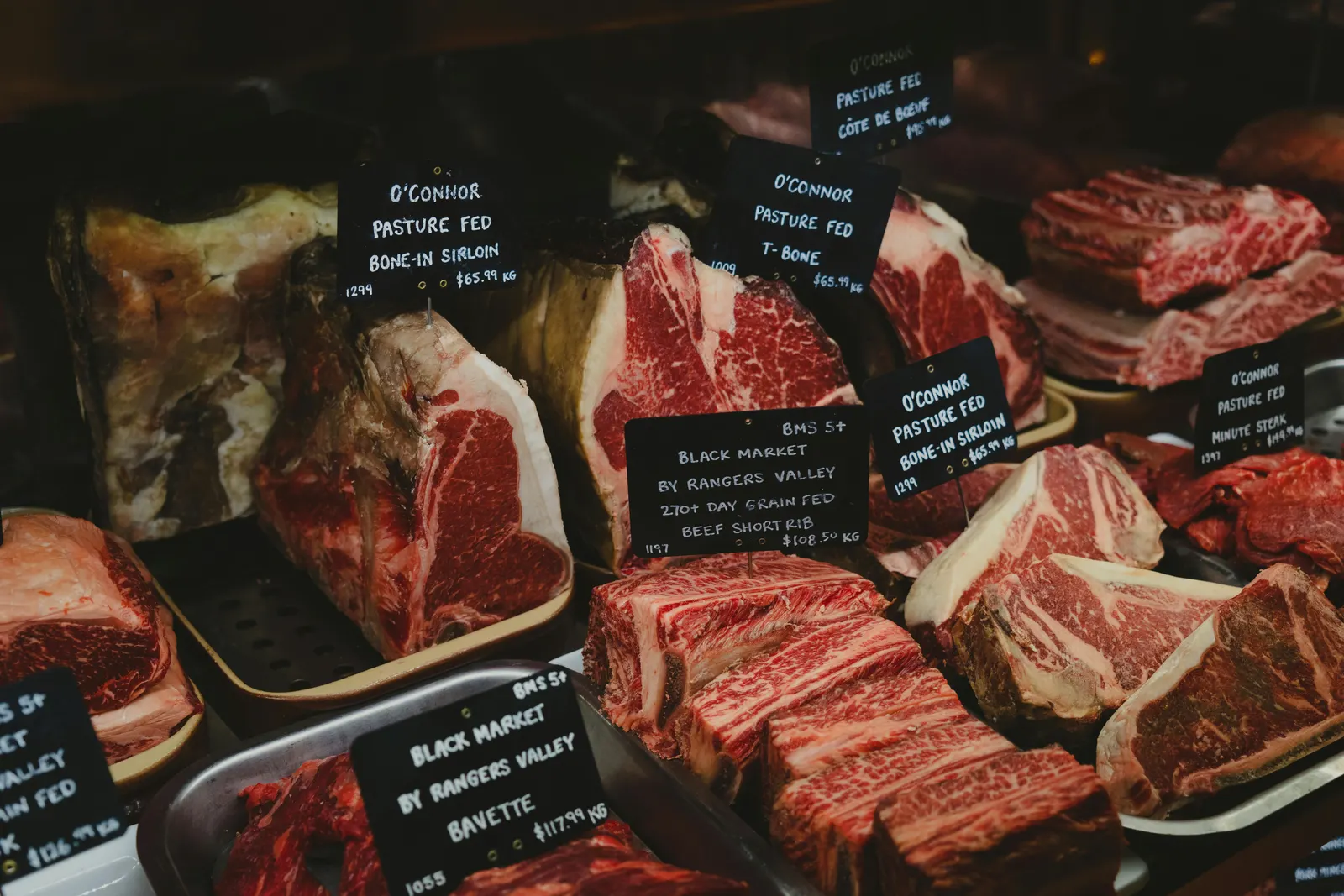
Prime and Choice are the two main USDA beef grades you'll see in American grocery stores. Prime has more marbling, the fine fat veins inside the muscle that carry flavor. Only about 3% of American beef qualifies for Prime; most is Choice. The price gap is usually 30 to 100% per pound. Whether the Prime upgrade is worth it depends on the cut, the occasion, and the specific piece of meat in front of you. A well-marbled Choice ribeye from a good butcher often eats better than a poorly marbled Prime from the supermarket. The grade is an average. The meat in your hand is the specific. Read the meat, not the sticker.
What Prime, Choice, and Select actually mean
The USDA grades beef on eight quality tiers. Only three of them ever appear in a normal grocery store: Prime, Choice, and Select. The other five (Standard, Commercial, Utility, Cutter, Canner) get processed into pet food, ground meat, or industrial use. So in practice, the grading conversation comes down to those top three.
The grading is based on marbling. A USDA grader visually assesses the cross-section of the ribeye between the 12th and 13th rib and judges how much fine intramuscular fat is distributed through the muscle. The more marbling, the higher the grade.
- Prime. The highest grade. The most marbling. Around 3% of American beef qualifies. Almost all of it goes to fine-dining restaurants and high-end butchers; a smaller fraction makes it to upscale grocery stores. Expect to pay 50% to 100% more per pound than Choice.
- Choice. The middle grade and by far the most common. Roughly two-thirds of American beef. Less marbling than Prime but still plenty for a good steak. This is what most American grocery stores carry as their default.
- Select. The lowest grade you'll see in a normal store. Significantly less marbling, leaner muscle, tougher when cooked. Sells for less but eats accordingly.
USDA grading is voluntary. Meat packers pay the USDA to have their beef graded, then the grade gets stamped on the meat. Ungraded beef can still be sold; it just doesn't carry a label.
Why the grade is an average, not a guarantee
This is the part most consumers never get told. The grade is an average across the animal, not a guarantee on the specific piece you're holding.
A USDA Prime designation means the ribeye between rib 12 and 13 on that particular animal hit the Prime marbling threshold. The other cuts on the same animal (the strip steak, the chuck, the brisket) inherit that grade as part of the whole-animal classification, but they don't necessarily have the same marbling distribution.
The practical result: a Prime strip steak from one animal might be heavily marbled. Another Prime strip steak from a different animal might be at the bottom edge of the Prime range, just barely qualifying. Both carry the same Prime sticker. They eat differently.
The reverse is also true. A Choice ribeye can sit at the high end of the Choice marbling range, just one step below Prime. Another Choice ribeye can be at the low end, barely above Select. Same sticker, two different steaks.
The consequence: a great Choice cut often eats better than a mediocre Prime cut. I've worked this from both sides of the line. In the restaurants I worked over the years, we used both Prime and Choice depending on the room. Fine-dining places leaned toward Prime, with dry-aged programs built on top. Casual dining ran Choice from a good purveyor. The Choice from a good purveyor was consistently better than Prime from a bad one.
The lesson: pick by what the meat in front of you looks like, not by what the label says.
When Prime is worth the upgrade
The Prime premium genuinely matters in a few specific situations:
- A premium grilling cut for a real occasion. A ribeye for an anniversary dinner. A porterhouse for a birthday. The marbling difference between Prime and Choice is most visible on cuts like ribeye and strip, where the high marbling creates the deepest crust and the richest mouthfeel. The full breakdown of which cuts respond best to the Prime upgrade is in the best cuts of beef for any occasion.
- Dry-aged cuts. Most dry-aging programs start with Prime beef because the aging process concentrates flavor, and you want the most flavor going in. A dry-aged Prime ribeye is a completely different eating experience than a fresh Choice. If you're going to spend on dry-aged, spend on Prime. On the ribeye vs strip question specifically, the strip benefits from dry-aging more than the ribeye does — its cleaner beef profile carries the concentrated flavor better.
- When the visible marbling is dramatically different. If you're at the case and the Prime cut has visibly more fat distribution than the Choice next to it, the upgrade is justified. The eye is the final judge, not the sticker.
At home, I upgrade to Prime when it's a real occasion. A special dinner for me and my wife. A celebration meal. Otherwise I'm running Choice from a good butcher and pocketing the difference. The same where-to-spend logic applies to a tomahawk's bone-weight premium: put the money into the meat, not the spectacle.
When Choice is the smarter buy
Choice is the right call for most home cooking, most of the time:
- Weeknight or weekend regular cooking. The marbling difference between a good Choice and a mediocre Prime is small enough that you won't notice it across a normal week of cooking.
- Anything that's going to be cooked past medium. Past medium, the marbling renders out into the pan anyway. You're paying a premium for fat you're going to cook off. Save the money.
- Anything going into a long-cooked dish. A beef stew, pot roast, braised short rib. The slow cooking renders fat and breaks down collagen; the starting grade matters less than the cut itself.
- Ground beef. Always Choice or better, but no reason to pay for Prime ground. The grind blends muscle and fat anyway; the grade matters less when the meat is mechanically restructured.
- Thin working cuts. With cuts like hanger and skirt steak, the cut choice itself does the work; the USDA marbling score, which is taken on the ribeye, says very little about a piece of meat from the diaphragm.
- Filet mignon. You buy filet for tenderness, not fat, so the Prime premium buys the least on a filet of any premium cut. A Choice filet is nearly as tender as a Prime one, since the grade chases marbling this lean muscle barely has.
- When you have a good butcher. A great Choice cut from a butcher who actually picks his beef beats a mediocre Prime cut from a corporate purchasing program. Source beats grade.
The full version of this thinking is in what makes a good steak and why the butcher matters. The USDA grade is one signal among many; visible marbling on the specific piece of meat is a stronger one.
A note on Select
Select is the lowest grade that shows up in a normal grocery store. The marbling is noticeably lower than Choice. Cooked as a steak, Select is leaner, tougher, and less forgiving on heat. Cooked too high, it dries out fast.
Select is fine for:
- Long-braised dishes where the cut breaks down regardless of starting marbling
- Ground beef applications where the grind dominates the structure
- Any cooking method where the lean-versus-fat question isn't the main flavor driver
Select is wrong for:
- Anything you want to eat as a steak
- High-heat cooking where marbling does most of the work
- A special-occasion meal
If your only option is Select and you want a great steak, switch stores. If your only option is Select and you want a great pot roast, it's perfectly fine.
Where Wagyu fits (a different category entirely)
Wagyu is a separate conversation from USDA grading. The word means "Japanese cow" and refers to specific cattle breeds that produce dramatically higher marbling than any American breed. Real Japanese A5 Wagyu has a marbling score that exceeds the highest USDA Prime designation by a wide margin.
A few distinctions worth knowing:
- Real Japanese A5 Wagyu (Kobe, Matsusaka, Omi, and other regional designations) is its own category. Different breed, different feed, different grading system (the Japanese BMS scale runs 1 to 12). Costs $100 to $200 per pound and up. A small portion is a meal experience.
- American Wagyu is usually a crossbreed of Japanese Wagyu with American Angus. Higher marbling than US Prime but nowhere near A5. Costs 2 to 4 times what Prime costs.
- Australian Wagyu is the same crossbreed concept, often graded on its own scale.
For most home cooks, the Wagyu question is occasional. If you're celebrating something serious, a small portion of real A5 is the kind of meal you remember. American Wagyu sits between Prime and A5 in both price and quality and is worth trying once before you decide whether to make it a habit. For everyday cooking, save the Wagyu money and buy a great well-marbled Choice from a butcher instead.
How to read the meat at the case
Forget the grade sticker. The actual signal is what your eyes tell you. A short field guide:
- Look at the marbling first. Fine white veining distributed evenly through the muscle. The more, the better. This is the single most important signal, regardless of what the grade label says.
- Compare side by side. If you can see Prime and Choice cuts in the same case, put them next to each other. Sometimes the Choice has more visible marbling than the Prime. When that happens, buy the Choice and save the premium.
- Color. Deep red. Vacuum-sealed beef can look dark or purplish in the package; that's normal. Avoid gray, brown, or anything that looks dried out.
- Edges. Cleanly cut, not ragged. Ragged edges mean the meat has been sitting.
- Ask if you can. A butcher will tell you which cut is the best one in the case right now. The supermarket case has no one to ask.
The grade is one signal. The meat in front of you is the truth. Trust your eyes. And once you have the right cut in your kitchen, the right way to salt it matters more than any grade upgrade ever will.
FAQ
What's the difference between Prime and Choice beef?
Prime has more marbling than Choice. Marbling is the fine fat veining inside the muscle, which carries flavor and contributes to tenderness during cooking. Only about 3% of American beef qualifies as Prime; most is Choice. Prime costs roughly 30 to 100% more per pound than Choice. Both grades produce good steaks, but the marbling difference is most visible on premium cuts like ribeye and strip steak.
Is Prime beef worth the extra money?
Sometimes. For premium grilling cuts (ribeye, strip, porterhouse) on a special occasion, the Prime upgrade is worth the extra cost. For everyday cooking, slow-cooked dishes, ground beef, or anything cooked past medium, Choice is the smarter buy. The single biggest factor is the visible marbling on the specific cut in front of you, not the grade label on the package.
How do I know if I'm getting good Choice beef?
Look at the marbling. A Choice cut at the high end of the Choice range has visible fine white veining distributed evenly through the muscle. A Choice cut at the low end barely has any marbling at all. The grade is an average; the specific cut varies a lot. A heavily marbled Choice ribeye often eats better than a poorly marbled Prime ribeye, even though the Choice costs less.
What's the difference between Choice and Select beef?
Select has noticeably less marbling than Choice and reads as leaner, tougher, and less forgiving on heat. Select is fine for long-braised dishes and ground beef applications, but wrong for high-heat steak cooking. Choice has enough marbling for good steaks; Select usually doesn't. If your grocery store only carries Select and you want a great steak, switch stores.
Is Wagyu beef the same as Prime?
No, Wagyu is a completely different category. Wagyu refers to specific Japanese cattle breeds that produce far higher marbling than any American breed. Real Japanese A5 Wagyu exceeds the highest US Prime grade by a wide margin and is graded on its own scale, separate from USDA grading. American Wagyu is a crossbreed of Wagyu with Angus, producing beef that sits between Prime and true A5 in both marbling and price.